
How to Start a Business in Florida
Florida has more than 3.1 million small businesses. They employ over 3.4 million people.

In This Article
- All Steps at a Glance
- Key Facts & Fees
- Before You Start
- 1. Validate Your Business Idea
- 2. Write a Business Plan
- 3. Choose Your Business Structure
- 4. Choose and Register Your Business Name
- 5. Register Your Business with the State
- 6. Get Your Federal EIN
- 7. Get Your Licenses and Permits
- 8. Open a Business Bank Account
- 9. Set Up Accounting and Understand Your Taxes
- 10. Get Business Insurance
- 11. Build Your Online Presence
- 12. Stay Compliant After Forming
- State Background
- FAQ
- Next Steps
The Complete Guide
How to Start a Business in Florida — 12 Steps
This is a full walkthrough: entity selection, state registration, federal tax IDs, licenses, banking, insurance, and ongoing compliance. Every step includes the official Florida links, fees, and timelines.
Cost depends on your structure. A sole proprietorship may cost nothing to start. An LLC costs $125 to file online. A corporation costs $70. Step 3 walks through every option.
Florida: Key Business Facts
Updated August 29, 2026- LLC Filing Fee (Online)
- $125
- Sole Proprietorship / DBA
- $50
- Corporation Filing
- $70
- Processing Time
- 3-5 business days
- Expedited Option
- $100 / 1-2 business days
- State Income Tax
- None
- Sales Tax Rate
- 6%
- Gross Receipts Tax
- No
- Franchise / Annual Tax
- 5.5% corporate income/franchise…*
- Filed With
- Florida Division of Corporations
- State Business License
- Not required (check local)
- Last Verified
- August 29, 2026
* Franchise / Annual Tax: 5.5% corporate income/franchise tax (C-Corps only, on income over $50,000)
Local licenses: Florida asks for no general state business licence. Your county almost certainly does. Most cities and counties want a local business tax receipt, which older guides still call a local business licence, and the fee is usually somewhere between $20 and $50. Ring your county tax collector before you open the doors, or start at the Florida Department of Revenue if you also need a sales tax permit.
What It Takes to Start a Business in Florida
Florida has more than 3.1 million small businesses. They employ over 3.4 million people. There is no personal state income tax, an LLC costs $125 to file, and the state runs the third largest economy in the country. That combination is why Florida takes more new business filings than almost anywhere else. This guide walks the whole route, from testing the idea to staying in good standing after you launch.
Starting a Florida business takes 12 steps. They run from testing your idea to filing your first annual report. The Division of Corporations, which everyone calls SunBiz, handles every entity filing online.
Your minimum first year cost is $263.75. That is the $125 formation fee plus the $138.75 annual report. You will also need an EIN, a business bank account, and whatever licence your city or county asks of your trade.
Validate Your Business Idea
Check that your idea fits the Florida economy before you spend a dollar. The big sectors here are:
- Tourism and hospitality, which drew over 140 million visitors in 2023
- Healthcare and life sciences, the fastest growing sector in the state
- Real estate, construction and professional services
Book a free session with the Florida SBDC Network. It costs nothing. You get market research tools, a look at your competition, and one to one advice.
Pro Tip
Write a Business Plan
You need a written plan if you want bank money or an SBA backed loan. Write it down. Lenders expect at least 12 months of projections, a clear picture of how you make money, and a description of who buys from you.
Our business plan guide has a free template covering every section they look for. The Florida SBDC will read your draft for free too. Take them up on it.
Pro Tip
Choose Your Business Structure
Most Florida founders pick an LLC. It protects your personal assets, passes income straight to you, and escapes the 5.5% corporate income and franchise tax that C-Corps pay. Filing one costs $125 at the Florida Division of Corporations.
There are four structures worth knowing. Sole proprietorship, LLC, S-Corp and C-Corp. Compare them below before you choose, or read our Florida LLC guide for the long version.
Pro Tip
Business Structure Comparison — Florida
Full comparison guide| Structure | Florida Filing Cost | Personal Liability | How You're Taxed | Best For |
|---|---|---|---|---|
| Sole Proprietorship | $50 (DBA) | ❌ None | Personal income tax. No separate return. | Freelancers, consultants, side hustles testing an idea with no employees. |
| LLC Most Common | $125 online | ✅ Personal assets protected | Pass-through by default. Elect S-Corp when profitable. | Most small businesses. Best balance of liability protection, flexibility, and tax options. |
| S-Corporation | ~$125 + IRS election | ✅ Personal assets protected | Pass-through. Owners pay themselves a salary — can reduce self-employment tax. | Profitable businesses (typically $50K+ net) where payroll tax savings justify the complexity. |
| C-Corporation | $70 | ✅ Personal assets protected | Corporate tax rate (21% federal). Double taxation on dividends. | Startups planning to raise VC funding, issue stock options, or eventually go public. |
| General Partnership | Free / No State Filing | ❌ None — all partners personally liable | Pass-through. Each partner reports share on personal return. | Two or more owners who trust each other and don't need liability protection. |
Which should you choose? Most first-time founders in Florida pick an LLC — it protects your personal assets without the complexity of a corporation. If you're not sure, consult a CPA or business attorney before filing. Read the full Florida LLC guide →
Choose and Register Your Business Name
Search the SunBiz name database first. Your name has to be distinguishable from every other entity on file. An LLC also has to carry LLC or Limited Liability Company in the name itself.
You can hold a name for 120 days. A reservation costs $25. Trading under a different name means filing a fictitious name, or DBA, which is $50.
Pro Tip
Check Florida Business Name Availability
Search the official Florida Division of Corporations database before you file.
Register Your Business with the State
File your Articles of Organization online for $125. That is a $100 filing fee plus a $25 registered agent designation fee. Both are compulsory.
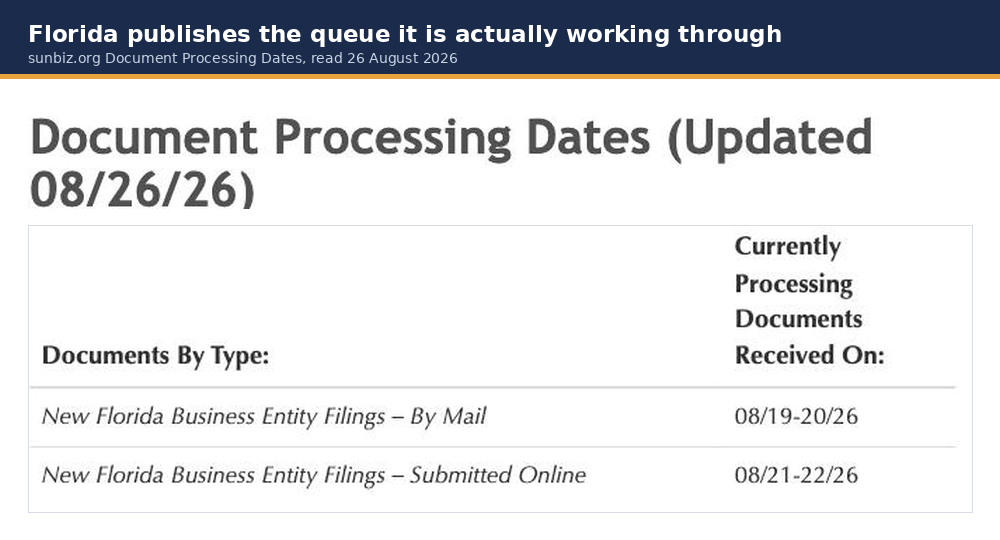
Standard processing runs about three business days. The Division publishes the receipt date it is currently working through, so you can read the real queue instead of guessing. On 26 August 2026 it was clearing online filings received on 21 and 22 August. There is no expedited service at any price, so a clean form filed online is the fastest route that exists.
A stamped Certificate of Organization comes back once it is approved. Keep it safe. Every Florida LLC has to keep a registered agent with a real Florida street address. Our Florida registered agent guide covers the cheap options.
Pro Tip
Important
File Online with Florida Division of Corporations
Official Florida business registration portal. Standard processing: 3-5 business days.
Get Your Federal EIN
Get your Employer Identification Number straight from the IRS online portal. It is free. It takes about 10 minutes and the number is issued on the spot.
You need an EIN to open a business bank account, to hire anyone, and to file federal tax. Single member LLCs with no staff need one too. There is no exemption.
Pro Tip
Get Your Licenses and Permits
Florida has no general state business licence. What you need depends on your trade and your address. Most businesses here need some mix of these:
- Sales tax permit if you sell anything taxable, free from the Department of Revenue
- Local business tax receipt, wanted by most counties and cities, from your county tax collector
- Professional licence for contractors, healthcare, estate agents, cosmetologists and other regulated trades, through the Florida DBPR
- Employer registration before your first hire, with the Department of Revenue for reemployment tax
Pro Tip
Important
Open a Business Bank Account
Take your EIN letter, your Articles of Organization, photo ID and your operating agreement to the bank. That is the whole list. Keeping business money apart from your own is what holds your liability protection together.
Compare the fees in our best business bank accounts guide. Several online banks charge nothing and ask for no minimum balance.
Pro Tip
Set Up Accounting and Understand Your Taxes
Florida charges no personal state income tax. Income from an LLC, an S-Corp or a sole proprietorship reaches you without the state taking a cut. C-Corps are the exception and pay 5.5% on net income above $50,000.
Sales tax is 6%, plus a county surtax of up to 2.5%. Register first. Go to the Department of Revenue before your first taxable sale, not after it.
Get accounting software running on day one. Track what comes in, what goes out, and what sales tax you are holding. Our accounting software picks start at nothing a month.
Pro Tip
Get Business Insurance
Florida requires workers compensation insurance once you have four employees, or just one if you are in construction. General liability is the other one. Nobody makes you buy it, and every business should have it anyway.
Compare cover and prices in our business insurance guide. A small service business usually starts around $30 to $50 a month.
Pro Tip
Important
Build Your Online Presence
Claim your Google Business Profile first. It is free. It puts you on Google Maps and into local search, which matters a great deal in a state that runs on visitors.
Then build something simple. Our website builders guide covers the platforms. One page with your services, your location and a way to reach you is enough to open with.
Pro Tip
Stay Compliant After Forming
Staying in good standing means keeping up with a short list of duties:
- Annual report due by May 1 every year, $138.75 for an LLC, filed at SunBiz
- A $400 late fee if it arrives after May 1 but before the third Friday in September
- Sales tax returns monthly, quarterly or twice yearly depending on your volume, at the Department of Revenue
- A registered agent kept at a real Florida address at all times
- Fictitious name renewal every 5 years for $50 if you trade under a DBA
- Local business tax receipt renewed yearly with your county
Miss May 1 and it costs $400. Miss the third Friday in September and the state can dissolve the company administratively.
Pro Tip
Important
Florida Business Background & Context
State-specific data to help you plan — taxes, economy, funding, and what to expect after you form.
Florida Business Climate
Frequently Asked Questions
What to Do Next
Once you've registered your Florida business, take these steps to set up for success.
Form Your Florida LLC
Follow our step-by-step Florida LLC guide to file your Articles of Organization with SunBiz for $125.
Start Your LLC →
Get a Florida Registered Agent
Compare top registered agent services with a physical Florida address starting at $49/year.
Compare Agents →
Open a Business Bank Account
Separate your personal and business finances with a free or low-cost business checking account.
Compare Accounts →
Connect with the Florida SBDC
Access free business consulting, market research, and loan packaging help at 40+ locations statewide.
Find Your SBDC →
Write Your Business Plan
Use our free business plan template to create a plan that lenders and investors expect to see.
Get the Template →
Disclaimer: This guide is for informational purposes only and does not constitute legal or tax advice. Requirements change — always verify current fees and requirements directly with Florida Division of Corporations and the IRS before filing.

Ready to Form?
Get your Florida business registered with Northwest. $39 + state fee includes registered agent, business address, domain, and more.
Was this article helpful?
Questions about starting a business in Florida
3 comments
manny_o
September 5, 2026
do i get the county thing or the city thing. im in a strip unit that has a city address but everyone keeps saying go to the tax collector. dont want to pay twice for the same piece of paper
Rosalie Fenn
August 11, 2026
I am not ready for a company yet, I just want to trade under a name that is not mine while I see whether this works. Your page gives one fee for that. A friend who did it last year says there was a newspaper bill on top that nobody warns you about. Is that still a thing?
Jennifer PayneGeekdiys team
Director of Entrepreneurial Strategy · August 13, 2026
Still a thing, and we should have said so on the page. Registering a trade name in Florida has two parts. Before the state will take the registration, the name has to be advertised at least once in a newspaper circulating in the county where your main place of business is. That is a separate bill from a separate business, usually modest, and it varies by paper. The state fee comes after. So budget both. Worth knowing that the trade name gives you the name and nothing else, no liability separation and no exclusivity, so treat it as a signboard rather than protection while you test the idea.
Leave a comment