
How LLCs Are Taxed
Your LLC does not have its own tax rate. You pay 15.3% self-employment tax plus your personal income tax rate on all profits, unless you elect S Corp or C Corp status.

In This Article
Definition
An LLC pays no separate federal tax; instead, profits pass through to owners who pay self-employment tax (15.3%) plus personal income tax.
LLCs are taxed as pass-through entities by default. Single-member LLCs file on Schedule C (Form 1040). Multi-member LLCs file Form 1065 as partnerships. Both pay 15.3% self-employment tax plus personal income tax on all net profits. You can elect S Corp status (Form 2553) or C Corp status (Form 8832) for potentially lower taxes.
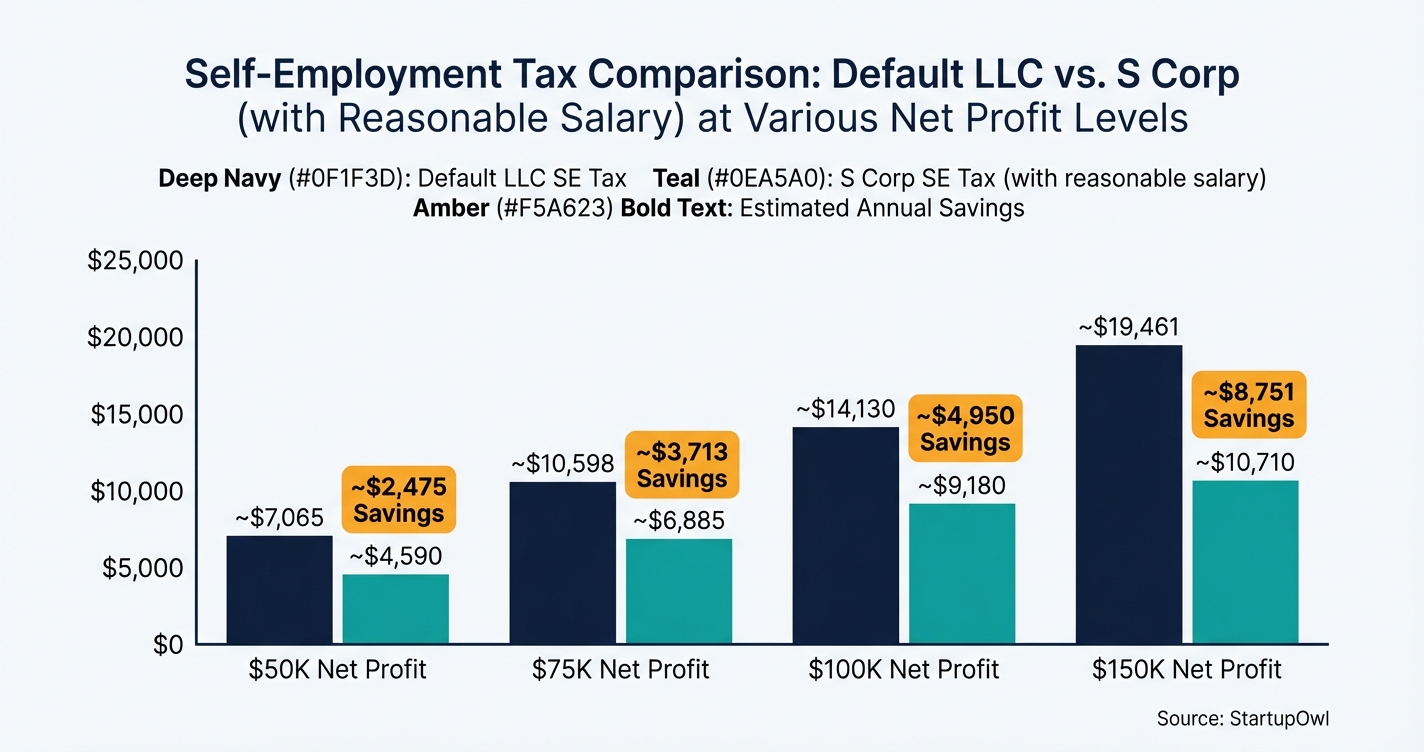
Your LLC's default tax bill is 15.3% in self-employment tax, on top of your federal income tax rate (10% to 37% for 2026). A single-member LLC earning $100,000 in net profit owes roughly $14,130 in self-employment tax alone, before any income tax. You have four classification options. Electing S Corp status cuts that self-employment bill by about $4,950 a year, before the payroll and filing costs it adds.
DIY filing with IRS Free File or free tax software (simple Schedule C only)
Free Option
$0 to $149 for the federal return using tax software such as TurboTax, state returns billed separately
Low-End
$192 on top of a $220 Form 1040 for a CPA-prepared Schedule C, $733 for a partnership return, on the last national averages
Mid-Tier
$903 for a CPA-prepared S Corp return (Form 1120-S) on the same averages, plus about $660 a year to run payroll
Premium
An LLC (limited liability company) is a state-level legal structure, but the IRS does not have a special "LLC tax rate." Instead, your LLC's profits flow through to your personal tax return and are taxed at your individual income tax rate. On top of that, you owe 15.3% self-employment tax on net earnings, which covers Social Security (12.4%) and Medicare (2.9%).
Think of it like this: if you had a job that paid you $100,000, your employer would pay half of your Social Security and Medicare taxes. As an LLC owner, you pay both halves. That doubles your FICA obligation compared to a W-2 employee earning the same income.
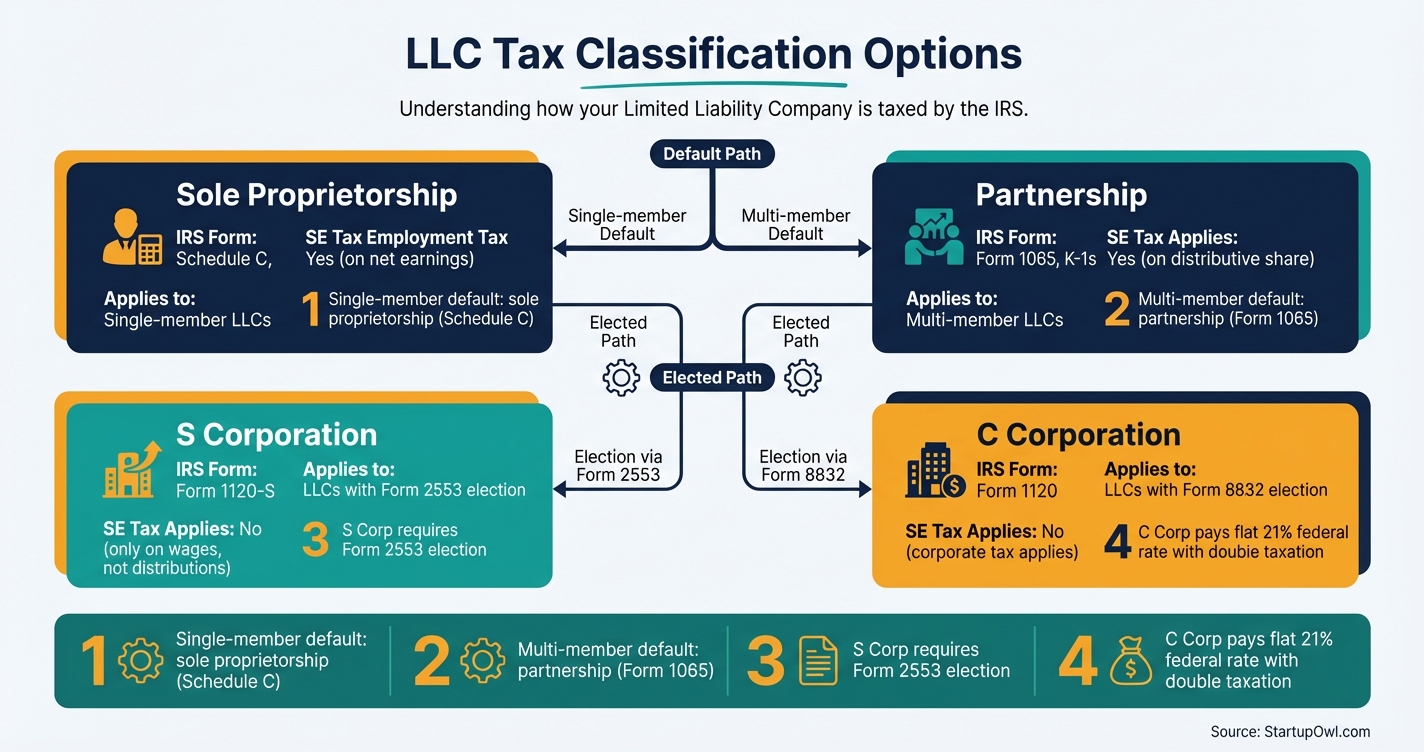
The IRS gives your LLC four possible tax classifications, each with different forms, deadlines, and tax consequences.
- Sole proprietorship (default for single-member LLCs) reports on Schedule C of Form 1040. All net profit is subject to self-employment tax.
- Partnership (default for multi-member LLCs) files Form 1065 and issues Schedule K-1 to each member. Each member pays SE tax on their share.
- S Corporation (elected via Form 2553) files Form 1120-S. Owners split income between salary (subject to payroll tax) and distributions (not subject to SE tax).
- C Corporation (elected via Form 8832) files Form 1120 and pays a flat 21% federal corporate tax. Dividends to owners are taxed again at the shareholder level.
Choosing the wrong tax classification (or sticking with the default when you should not) can cost you thousands of dollars every year. A single-member LLC earning $100,000 in net profit pays approximately $14,130 in self-employment tax. If that same LLC elected S Corp status and paid a $60,000 reasonable salary, the payroll tax on that salary would be $9,180, a saving of about $4,950 a year. The gap widens as profit grows. At $200,000 in net profit with a $100,000 salary, self-employment tax of roughly $28,234 becomes $15,300 in payroll tax, a saving near $12,930. Both figures are before the payroll processing and second tax return the election adds, which together run past $1,500 a year.
Missed quarterly estimated tax payments trigger an IRS underpayment penalty. If you expect to owe $1,000 or more, you must pay estimated taxes using Form 1040-ES four times per year. The safe harbor rule says you must pay at least 100% of last year's total tax liability (or 110% if your AGI exceeded $150,000).
State taxes add another layer. California, for example, charges an $800 annual LLC franchise tax regardless of income. Some states like Florida, Texas, and Wyoming have no state income tax, while New Jersey tops out at 11.5% for corporate income. Your total tax burden depends heavily on where your LLC operates.
This content is for informational purposes only and does not constitute financial, legal, or tax advice. Business setup requirements, costs, and regulations vary by state, industry, and business structure. Consult a qualified CPA, attorney, or licensed insurance agent for advice specific to your situation.
Here is how each LLC tax classification works in practice for 2026. Dates below assume a calendar year. When a federal due date lands on a weekend or on a holiday in the District of Columbia, it moves to the next business day, which is why some years read March 16 or April 18 instead.
Single-member LLC (sole proprietorship)
- You report all business income and expenses on Schedule C (Form 1040).
- Net profit is subject to self-employment tax at 15.3% (calculated on 92.35% of net earnings).
- The Social Security portion (12.4%) applies to earnings up to $184,500 for 2026. Medicare (2.9%) applies to all earnings, with an extra 0.9% surtax on income above $200,000 (single).
- You can deduct 50% of your SE tax as an above-the-line deduction on Form 1040.
- Your 2026 return is due April 15, 2027, the 15th day of the fourth month after the tax year ends.
Multi-member LLC (partnership)
- The LLC files Form 1065 and issues a Schedule K-1 to each member.
- Each member reports their share of income on their personal return and pays SE tax on active business income.
- Form 1065 for the 2026 tax year is due March 15, 2027, the 15th day of the third month after year end.
S Corporation election
- File Form 2553 no more than 2 months and 15 days after the start of the tax year the election is to cover, or any time during the year before it. The window closes March 15.
- You must pay yourself a "reasonable salary" subject to payroll taxes. Remaining profits are taken as distributions not subject to SE tax.
- The LLC files Form 1120-S annually, due March 15, 2027 for the 2026 tax year.
- Requirements include being a domestic entity, having no more than 100 shareholders, only one class of stock, and only allowable shareholders (U.S. citizens or residents; no other entities as owners).
C Corporation election
- File Form 8832 with the IRS.
- The LLC pays a flat 21% federal corporate income tax on net profits. Dividends to owners are then taxed at the shareholder's personal rate, creating double taxation.
- Form 1120 for the 2026 tax year is due April 15, 2027.
The QBI Deduction (Section 199A)
Pass-through LLC owners (sole proprietorships, partnerships, and S Corps) may deduct up to 20% of qualified business income. The OBBBA, signed into law on July 4, 2025, made this deduction permanent. For 2026, limitations begin at $201,750 (single) or $403,500 (married filing jointly), with phase-outs extending to $276,750 (single) or $553,500 (MFJ). A new minimum deduction of $400 applies if your QBI is at least $1,000. Learn more about the LLC vs S Corp tax comparison.
If you already have an LLC, your tax classification is already set to the default. Here is how to change it or get started with filing.
Step 1: Determine your current classification. Single-member LLCs are automatically taxed as sole proprietorships. Multi-member LLCs default to partnership taxation. If you have never filed Form 2553 or 8832, you are on the default.
Step 2: Run the S Corp math. If your net profit consistently exceeds $50,000 to $60,000, the S Corp election likely saves you money. At $100,000 in net profit with a $60,000 salary, you would save approximately $4,950 in self-employment taxes. Factor in the two costs the election adds. Payroll processing starts at roughly $660 a year for a single owner-employee, on Gusto's entry level plan at $49 a month plus $6 per person as advertised on August 21, 2026, and the Form 1120-S itself averaged $903 in the most recent National Society of Accountants fee survey. Both of those are floors, so check whether the net saving still justifies the switch at your own numbers.
Step 3: File the election (if applicable). Submit Form 2553 no more than 2 months and 15 days after the start of the tax year you want it to cover, or any time during the year before. For an existing calendar year LLC that window closes on March 15. A new LLC counts from the day it first had owners, assets or business, so its window can end mid month rather than on the 15th. Late is not always fatal. Rev. Proc. 2013-30 relief runs for 3 years and 75 days from the effective date you enter, where you had reasonable cause and write FILED PURSUANT TO REV. PROC. 2013-30 across the top margin of the form.
Step 4: Get an EIN. If you do not already have one, apply free at IRS.gov. Multi-member LLCs and S Corps require an EIN. Read our EIN application guide for a step-by-step walkthrough.
Step 5: Set up quarterly estimated tax payments. Use Form 1040-ES to calculate and submit quarterly payments. Due dates for 2026 are April 15, June 15, September 15, and January 15, 2027. You can pay online at IRS.gov/payments or via the Electronic Federal Tax Payment System (EFTPS).
Step 6: Choose your tax prep method. For simple single-member LLCs, accounting software with built-in tax features may be enough. Once you add employees, an S Corp election, or multi-state operations, hire a CPA. The National Society of Accountants survey put the average hourly fee at $179.81 for S Corp work and $177.29 for partnership work, with large city firms charging well above that and rates having risen since.
LLC tax costs include the taxes you owe plus the cost of preparing and filing your returns. Here is what to budget for 2026.
Self-employment tax runs 15.3% on 92.35% of net earnings (effectively 14.13%). On $100,000 net profit, that is roughly $14,130. On $50,000, it is about $7,065.
Federal income tax comes on top of that. It runs on seven brackets for 2026. They apply to your taxable income, not to your net profit. Subtract half your self-employment tax, your standard deduction and the QBI deduction before you read the table.
| Rate | Single filer | Married filing jointly |
|---|---|---|
| 10% | Up to $12,400 | Up to $24,800 |
| 12% | $12,401 to $50,400 | $24,801 to $100,800 |
| 22% | $50,401 to $105,700 | $100,801 to $211,400 |
| 24% | $105,701 to $201,775 | $211,401 to $403,550 |
| 32% | $201,776 to $256,225 | $403,551 to $512,450 |
| 35% | $256,226 to $640,600 | $512,451 to $768,700 |
| 37% | Over $640,600 | Over $768,700 |
Source, IRS Revenue Procedure 2025-32, section 3.01. The 2026 standard deduction is $16,100 for a single filer and $32,200 for a joint return.
Put both taxes together and the bill lands below the headline rates. A single filer whose only income is the LLC pays about 19% of net profit at $50,000, 22% at $100,000 and 27% at $200,000, counting self-employment tax and income tax and claiming the QBI deduction in full. State tax sits on top. A spouse's salary or your own W-2 income pushes the rate up, because your LLC profit stacks on it.
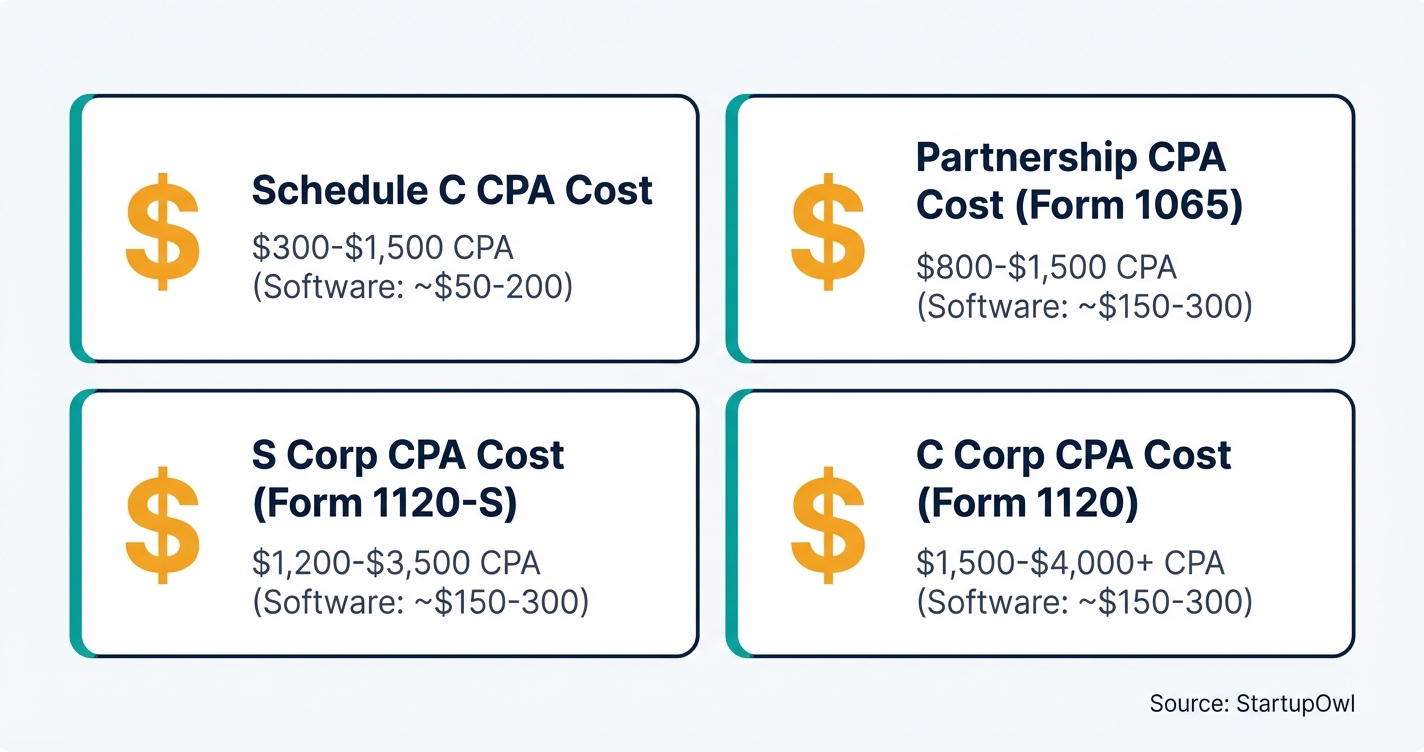
Tax preparation costs depend on which return your LLC has to file. The National Society of Accountants, a trade body for accountants and tax preparers, publishes national average fees by form. These are the figures from its most recent Income and Fees Survey, covering the 2020 and 2021 filing seasons.
- A Schedule C, which is how a single-member LLC reports its profit on the owner's personal return, added $192 on top of the $220 average for a basic Form 1040.
- Form 1065, filed by a multi-member LLC taxed as a partnership, averaged $733.
- Form 1120-S, filed by an LLC taxed as an S Corp, averaged $903, before the cost of running payroll.
- Form 1120, filed by an LLC taxed as a C Corp, averaged $913.
Treat those as a floor rather than a quote. They are five years old, and the National Association of Tax Professionals reported in its 2025 fee study that 83 percent of preparers raise their fees every one or two years, usually by 6 to 10 percent. Complexity, region and credentials move the number as well. The accountants' survey also found that 78 percent of firms charge extra when a client turns up with disorganized records, an average of $165.82 on top of the return itself. Ask for a written quote before you engage anyone.
Filing it yourself with software costs far less in the simplest case. TurboTax advertised its do-it-yourself online tiers from $0 to $149 for the federal return when we checked on August 21, 2026, with each state return billed separately, and those tiers cover a single-member LLC filing Schedule C. A partnership or S Corp return needs a business product or a preparer.
State-level costs add to the total. California's annual $800 LLC franchise tax is due every year regardless of revenue. States without income tax (Florida, Texas, Wyoming, Nevada, South Dakota, Washington) can reduce your burden. State corporate income tax rates range from 2% in North Carolina to 11.5% in New Jersey. Learn more about how to set up small business accounting.
Your LLC's ideal tax classification depends on what kind of business you run and how much you earn.
Freelancer or consultant (single-member LLC)
If your net profit is under $50,000, stick with the default sole proprietorship classification. The S Corp election adds payroll processing and a second tax return, which together run comfortably past $1,500 a year once you combine an entry level payroll plan with a Form 1120-S, and that cost would eat into any SE tax savings. Above $60,000 to $80,000 in net profit, run the numbers with a CPA.
E-commerce business
Online sellers often have high gross revenue but thin margins. Focus on your net profit (after COGS and expenses) when evaluating the S Corp breakeven. If your net is under $50,000, stay default. Watch for sales tax obligations in multiple states, which add compliance complexity beyond income taxes.
Professional services (law, medicine, accounting)
These are classified as Specified Service Trades or Businesses (SSTBs), which face special QBI limitations. If your taxable income exceeds $201,750 (single) or $403,500 (joint) for 2026, the QBI deduction phases out. Consider retirement plan contributions (SEP-IRA, Solo 401(k), or defined benefit plan) to reduce taxable income below the threshold. The S Corp election is almost always beneficial at these income levels.
Brick-and-mortar retail or restaurant
Businesses with employees typically benefit from the S Corp election once profitable. Payroll infrastructure is already in place, so the added cost of putting yourself on payroll is minimal. CPA tax prep runs well above the national average here, because inventory, payroll and multiple forms all add hours to the job.
Real estate investors
Rental income held in an LLC may qualify for the QBI deduction through the IRS safe harbor (requiring 250+ hours of rental services annually with contemporaneous records). Multi-member real estate LLCs should explore aggregation strategies to combine rental and operating entities for higher QBI deductions. See our LLC operating agreement guide for structuring tips.
These LLC tax mistakes cost real money. Avoid all of them.
1. Mixing personal and business finances. If the IRS audits you, commingled funds make it nearly impossible to prove deductions. Open a business bank account and keep every receipt. Disallowed deductions can cost you 36+ cents per dollar (SE tax + income tax) on every expense you cannot substantiate.
2. Missing quarterly estimated payments. The IRS charges an underpayment penalty (currently around 7-8% annualized) if you owe more than $1,000 at filing and did not pay enough throughout the year. Set calendar reminders for April 15, June 15, September 15, and January 15.
3. Electing S Corp status too early. If your net profit is below $50,000, the additional payroll costs, from roughly $660 a year for a single owner-employee, plus a separate Form 1120-S that averaged $903 nationally and costs more today, can exceed your self-employment tax savings. Run the numbers first.
4. Setting an unreasonably low S Corp salary. The IRS requires "reasonable compensation" for S Corp owner-employees. Paying yourself $20,000 on a business generating $200,000 in profit will trigger IRS scrutiny. The IRS can reclassify distributions as wages and assess back payroll taxes, penalties, and interest.
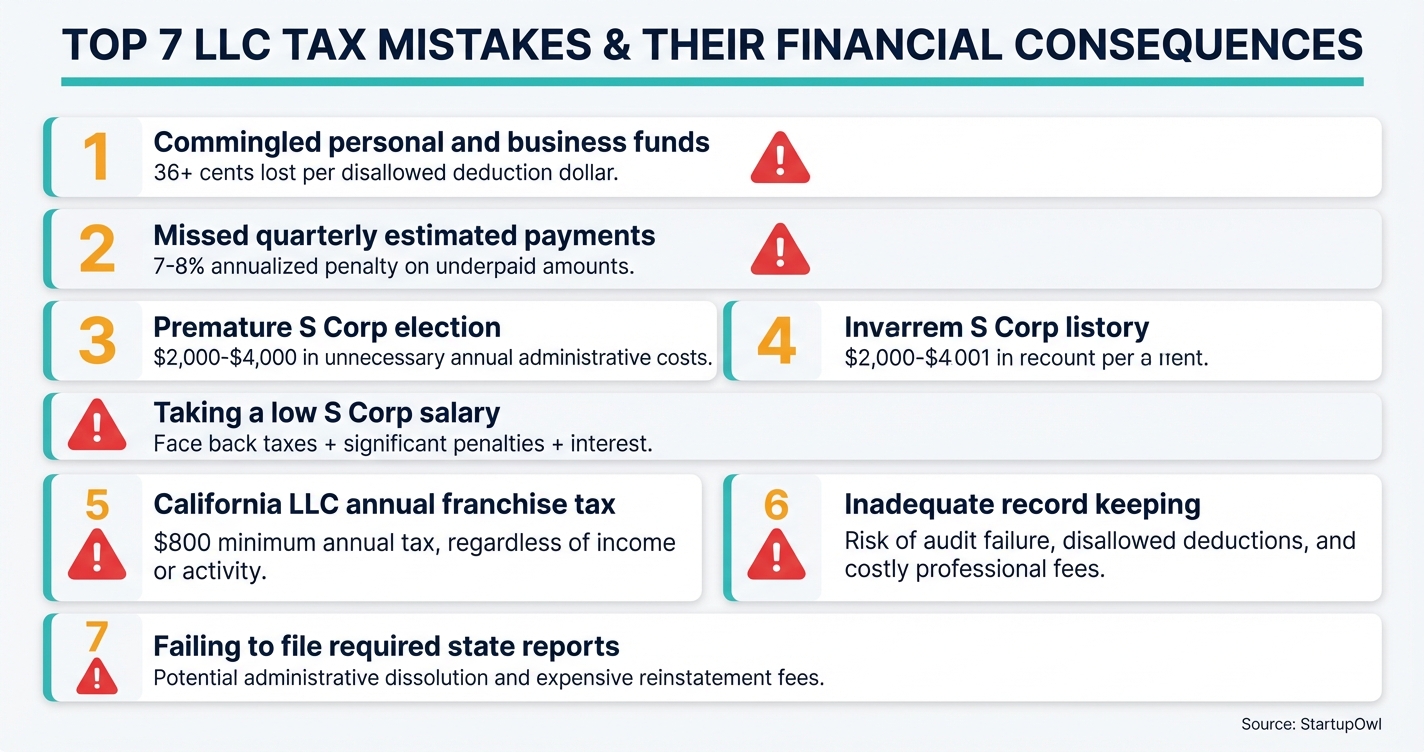
5. Ignoring state-level LLC taxes. California's $800 annual franchise tax applies even if your LLC earns zero income. California also charges a gross receipts fee of up to $11,790 for high-revenue LLCs. Some states do not recognize the S Corp election, adding separate state filing requirements.
6. Forgetting the QBI deduction. Eligible pass-through LLC owners can deduct up to 20% of qualified business income. On $100,000 in QBI, that is a $20,000 reduction in taxable income, saving roughly $4,400 to $7,400 depending on your bracket. Failing to claim it is leaving money on the table.
7. Not deducting half of self-employment tax. You can deduct 50% of your SE tax as an above-the-line adjustment on Form 1040. On $100,000 in net profit, that is a $7,065 deduction that reduces both your income tax and your effective SE tax rate.
Frequently Asked Questions
There is no single LLC tax rate. Your profits carry 15.3% self-employment tax plus your personal income tax, which runs on seven brackets from 10% to 37% for 2026. Together that is about 19% of net profit at $50,000 and 22% at $100,000 for a single filer with no other income. State tax sits on top.
The breakeven point is roughly $50,000 to $60,000 in annual net profit. Below that, the added costs of payroll processing and a more complex tax return outweigh the savings. The math flips above it. At $100,000 in net profit with a $60,000 salary, the election saves about $4,950 a year in SE tax, before the costs it adds.
For a calendar year LLC the 2026 window closed on March 16, 2026, the Monday after March 15 fell on a Sunday. Two doors are still open. File Form 2553 now to take effect for 2027, or ask for late election relief under Rev. Proc. 2013-30, which runs 3 years and 75 days from the date you want. Relief needs reasonable cause and the form marked FILED PURSUANT TO REV. PROC. 2013-30. A new LLC is different. Its window opens when it first had owners, assets or business.
Yes. If you expect to owe $1,000+ in federal tax for the year, you must make quarterly estimated payments using Form 1040-ES. Due dates for 2026 are April 15, June 15, September 15, and January 15, 2027. Missing payments triggers an underpayment penalty.
The Qualified Business Income (QBI) deduction lets pass-through LLC owners deduct up to 20% of qualified business income. For 2026, the full deduction is available if your taxable income is below $201,750 (single) or $403,500 (married filing jointly). The OBBBA made this deduction permanent and introduced a $400 minimum deduction for QBI over $1,000.
The National Society of Accountants, a trade body for accountants and tax preparers, publishes national average fees by form. In its most recent survey a Schedule C added $192 to the $220 average for a basic Form 1040, a partnership return on Form 1065 averaged $733, and an S Corp return on Form 1120-S averaged $903. Disorganized records added an average of $165.82 on top. Those figures cover the 2020 and 2021 filing seasons, so budget above them and ask for a written quote.
Yes, if your LLC is registered or does business in California. The $800 annual franchise tax applies regardless of income or profitability. It is due by April 15 each year. California also charges a separate gross receipts fee (up to $11,790) if your LLC's total revenue exceeds $250,000.
A standard LLC pays 15.3% self-employment tax on all net profit. An S Corp splits income in two. Salary is subject to payroll tax, distributions are not. At $100,000 profit with a $60,000 salary, you save roughly $4,950 in SE taxes, but you must run payroll and file a separate corporate return.
Sources & References
- IRS Self-Employed Individuals Tax Center
- IRS S Corporations
- IRS Qualified Business Income Deduction
- IRS Form 2553 Instructions (S Corp Election)
- IRS Form 1040-ES (Estimated Tax)
- Tax Foundation: 2026 Tax Brackets and Federal Income Tax Rates
- Tax Foundation: State Corporate Income Tax Rates and Brackets, 2026
- PwC: United States Corporate Taxes on Income
- National Society of Accountants, 2020-2021 Income and Fees Survey, National Averages
- NATP, How much do tax professionals charge in 2025
- Gusto Pricing, Plans and Fees
- TurboTax Online Products and Pricing
- IRS Revenue Procedure 2025-32, 2026 inflation adjustments (tax rate tables, standard deduction, section 199A)
Was this article helpful?
Questions about How LLCs Are Taxed, a Complete Tax Guide
No comments yet. Ask the first question and a member of our team will answer.
Leave a comment