
LLC vs S Corp, Which Is Right for You?
The real difference between an LLC and S Corp is how you pay self-employment tax. Here is exactly when each structure saves you more money.

- S Corp is a tax election, not a business type. Your LLC stays an LLC after filing Form 2553.
- The election breaks even near $70K net profit, where the tax it saves passes the roughly $2,000 a year it costs to run.
- SE tax runs 15.3% on 92.35% of net profit. The 12.4% Social Security half stops at $184,500 in 2026. The 2.9% Medicare half never stops.
- Form 2553 is due 2 months and 15 days after the tax year starts, so March 15, 2027 for a 2027 election.
An LLC taxed as a sole proprietorship pays 15.3% self-employment tax on all net profit. An LLC that elects S Corp status splits income between salary (taxed at 15.3%) and distributions (not taxed). For someone earning $100K in net profit, the split saves $6,480 in self-employment tax, and about $4,500 once payroll and the S Corp return are paid for.
An LLC and an S Corp are not an either/or choice. An LLC is a legal business structure filed with your state. An S Corp is a federal tax election you make with the IRS by filing Form 2553. You can (and often should) be both at the same time.
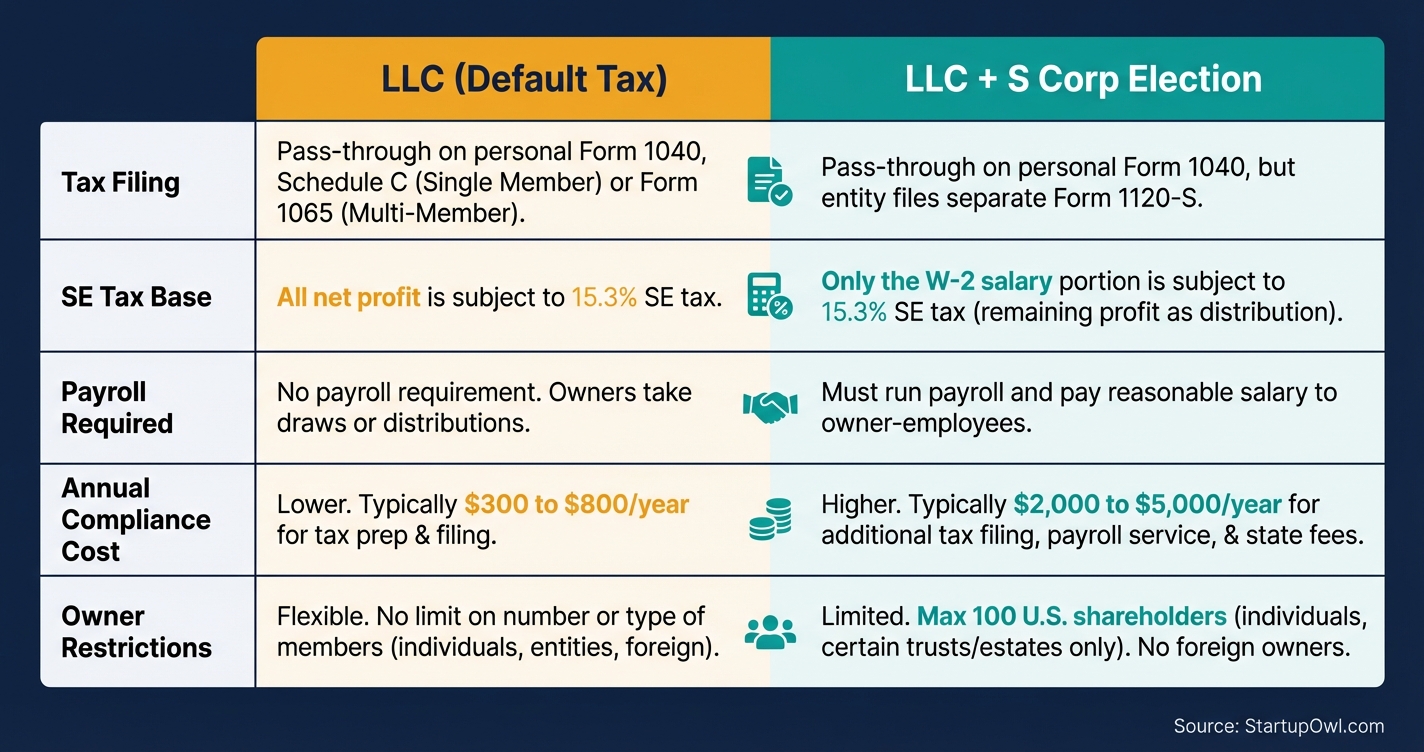
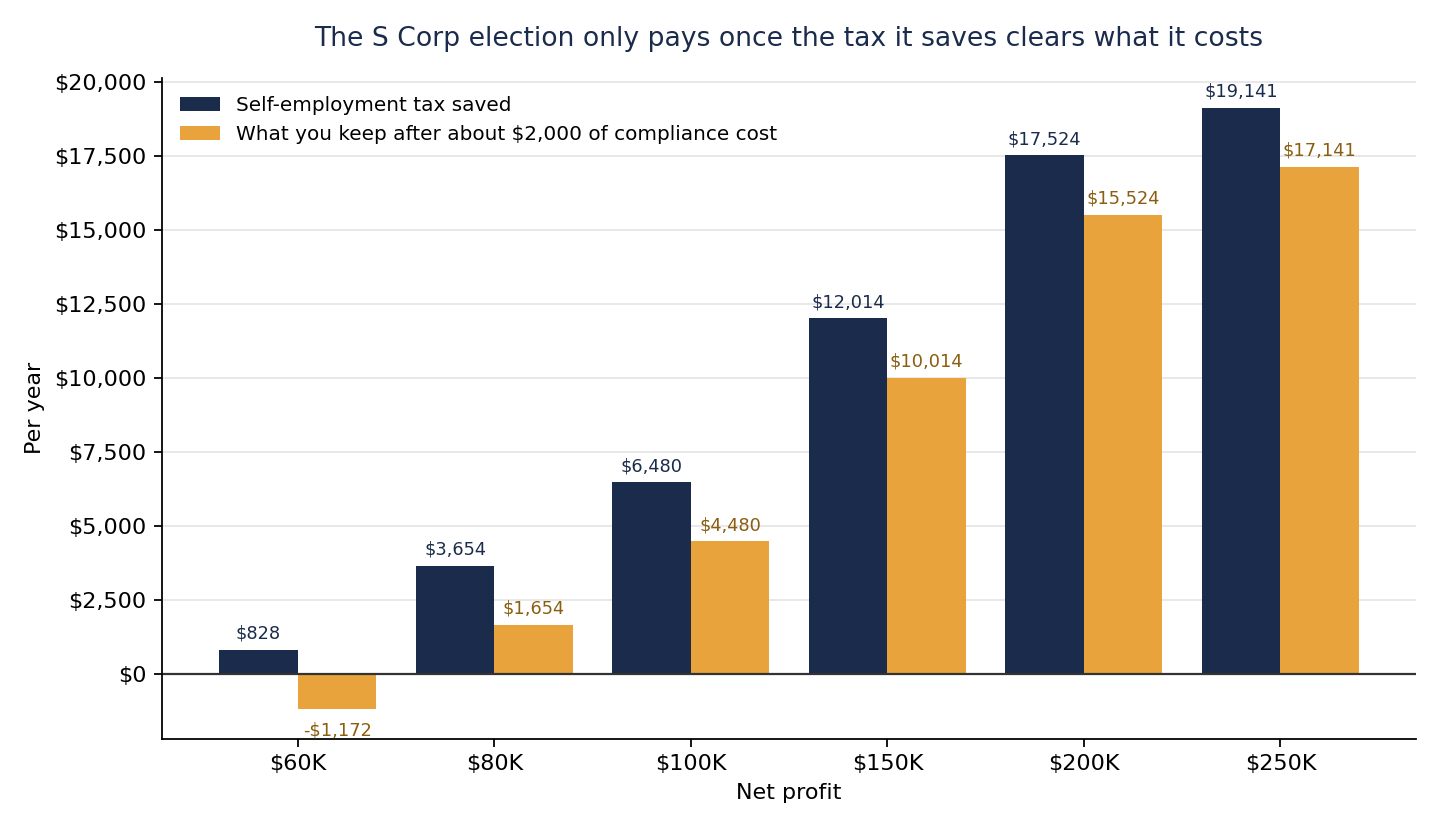
The practical question is whether you should elect S Corp taxation for your LLC. The election starts paying for itself around $70,000 of net profit, which is where the self-employment tax it saves passes the roughly $2,000 a year it costs to run. At $100,000 of profit you keep about $4,500. At $200,000, about $15,500. Below $60,000 it costs more than it saves.
LLC (Default Tax) vs LLC Taxed as S Corp at a Glance
| Factor | LLC (Default Tax) | LLC Taxed as S Corp |
|---|---|---|
| Tax Treatment | Pass-through. All net profit taxed on your personal return plus 15.3% SE tax. | Pass-through. Only salary is subject to 15.3% FICA. Distributions avoid SE tax. |
| Liability | Full personal asset protection. Members shielded from business debts and lawsuits. | Same as LLC. Full personal asset protection, identical legal structure. |
| Formation Cost | State filing fees range from $35 to $500. Average is $132. | LLC filing ($35 to $500) plus Form 2553 (free). Payroll setup adds $500+ yearly. |
| Formation Complexity | Simple. File Articles of Organization with your state SOS. | Moderate. File LLC first, then submit Form 2553 by mail or fax to the IRS. |
| Ongoing Compliance | Minimal. Annual report ($0 to $300) and operating agreement recommended. | Higher. Payroll, quarterly filings, Form 1120-S, K-1s, and W-2s required. |
| Management | Flexible. Member-managed or manager-managed, no board required. | Same flexible LLC structure, but must run formal payroll for owner-employees. |
| Ownership Limits | No limits. Unlimited members, foreign owners and entities allowed. | Max 100 shareholders, U.S. citizens/residents only, one class of stock. |
| Best For | Businesses under $70K net profit, foreign owners, or those wanting simplicity. | Profitable businesses above $70K net income seeking self-employment tax savings. |
S-Corp Tax Savings by Income Level
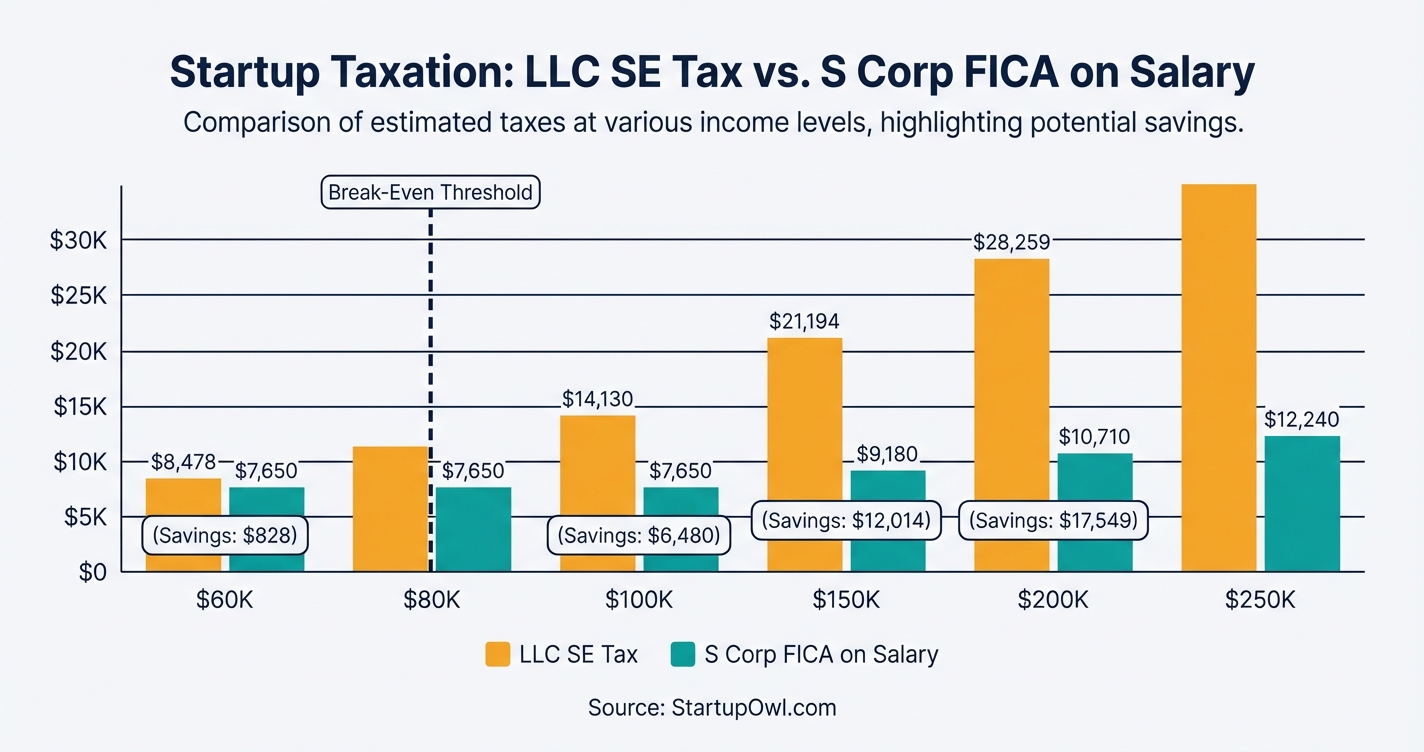
| Annual Income | LLC SE Tax | Est. S-Corp Savings |
|---|---|---|
| $60,000 | $8,478 | $828 on a $50,000 salary, less than the roughly $2,000 a year it costs to run |
| $80,000 | $11,304 | $3,654 on a $50,000 salary, about $1,650 after costs |
| $100,000 | $14,130 | $6,480 on a $50,000 salary, about $4,500 after costs |
| $150,000 | $21,194 | $12,014 on a $60,000 salary, about $10,000 after costs |
| $200,000 | $28,234 | $17,524 on a $70,000 salary, about $15,500 after costs |
| $250,000 | $29,851 | $19,141 on a $70,000 salary, about $17,100 after costs |
An LLC (Limited Liability Company) is a legal business structure you create by filing Articles of Organization with your state's Secretary of State. Filing fees range from $35 in Montana to $500 in Massachusetts, with the national average sitting at about $132 as of 2026.
By default, a single-member LLC is taxed as a sole proprietorship. You report all income and expenses on Schedule C of your personal Form 1040. The IRS hits all net profit with 15.3% self-employment tax (12.4% Social Security on the first $184,500 of income in 2026, plus 2.9% Medicare on all earnings).
The LLC itself offers real liability protection. Your personal assets (home, savings, car) are shielded from business debts and lawsuits. You get flexible management, unlimited members, and zero ownership restrictions. For a complete overview of how LLCs compare to other entity types, see our guide to business entity types.
An S Corp is not a type of business entity. It is a federal tax classification under IRC Section 1362 that you elect by filing Form 2553. Your LLC remains an LLC with your state. Only its IRS treatment changes.
The core benefit is the salary/distribution split. As an S Corp, you pay yourself a reasonable W-2 salary (subject to the 15.3% FICA tax), and then take remaining profits as distributions that are not subject to self-employment tax. On $100,000 of net profit with a $50,000 salary, payroll tax on the salary comes to $7,650 against $14,130 of SE tax on the whole profit. The saving is $6,480 before compliance costs.
S Corps come with real restrictions. You are limited to 100 shareholders, all of whom must be U.S. citizens or residents. You can only have one class of stock. You must file a separate Form 1120-S tax return, issue K-1s and W-2s, and run payroll. Learn more about eligibility and formation in our guide to starting an S Corp.
The only difference that matters for most owners is taxes. Your LLC's legal protection does not change when you elect S Corp status. Your operating agreement stays the same. Your state filings stay the same. The IRS is the only entity that sees a difference.
Tax Treatment Is the Deciding Factor
A default LLC pays 15.3% SE tax on 92.35% of net profit, and only the 12.4% Social Security half stops at the $184,500 wage base for 2026. The 2.9% Medicare half keeps running. That is $14,130 on every $100,000 of profit. An LLC taxed as an S Corp pays that 15.3% only on the owner's W-2 salary, not on the remaining distributions.
Example: You earn $150,000 in net profit. As a default LLC, your SE tax is approximately $21,194. As an S Corp with a $60,000 reasonable salary, your FICA tax is approximately $9,180. That is a difference of about $12,000. Take off the roughly $2,000 a year the election costs to run and you keep about $10,000.
Formation and Paperwork
Both paths start with the same LLC filing. The S Corp adds Form 2553, which cannot be filed online as of 2026. You must mail or fax it. Expect a CP261 confirmation letter from the IRS within 60 days.
Ongoing Compliance
A default single-member LLC files Schedule C on your personal return. An S Corp-elected LLC must file Form 1120-S (the S Corp return), issue Schedule K-1s to all owners, issue W-2s, run payroll at least quarterly, and file quarterly payroll tax forms (941). Two bills come with that. The National Society of Accountants Income and Fees Survey, whose most recent edition covers the 2020 and 2021 seasons, puts the average Form 1120-S fee at $903. A basic payroll service adds roughly $660 a year for one owner-employee, going by Gusto Simple at $49 a month plus $6 per person, read at gusto.com on 25 August 2026. That is about $1,560 at the survey's own fee levels. Preparers have raised prices since. The NATP 2025 Fee Study found 83 percent of them raise fees every one or two years, usually by 6 to 10 percent, so budget nearer $2,000 today. Paid bookkeeping sits on top.
Ownership and Management
Default LLCs have no ownership restrictions. S Corps are limited to 100 shareholders, must be U.S. citizens or residents, and allow only one class of stock. If you have foreign investors or want multiple equity tiers, you cannot elect S Corp status.
Pros and Cons of Staying with Default LLC Taxation
- Pro: Simplest tax filing. Single-member LLCs report on Schedule C with no separate business return.
- Pro: No payroll required. You take owner draws, not a salary.
- Pro: No ownership restrictions. Unlimited members, foreign owners, multiple equity classes.
- Pro: Lowest compliance costs. Skip the payroll service, the 1120-S prep, and the W-2/K-1 requirements.
- Con: Full 15.3% SE tax on 92.35% of net profit, with only the 12.4% Social Security half capped at $184,500 in 2026.
- Con: Higher total tax bill once profits clear roughly $70K compared to S Corp.
Pros and Cons of Electing S Corp Taxation for Your LLC
- Pro: Save real money once profit clears roughly $70,000. The saving is $6,480 at $100,000 of profit and $12,014 at $150,000. Both are before costs.
- Pro: Better positioning for the 20% QBI deduction with W-2 wage optimization.
- Pro: Retains full LLC flexibility at the state level.
- Con: Must pay yourself a reasonable salary. The IRS reclassifies distributions as wages (plus penalties) if your salary is too low.
- Con: Added compliance costs of about $2,000 a year for payroll and the 1120-S return, more if you pay for bookkeeping.
- Con: Ownership limited to 100 U.S. shareholders, one class of stock only.
Choosing between default LLC taxation and S Corp election comes down to your net profit, your ownership structure, and your tolerance for compliance costs. Use these if/then scenarios to find your fit.
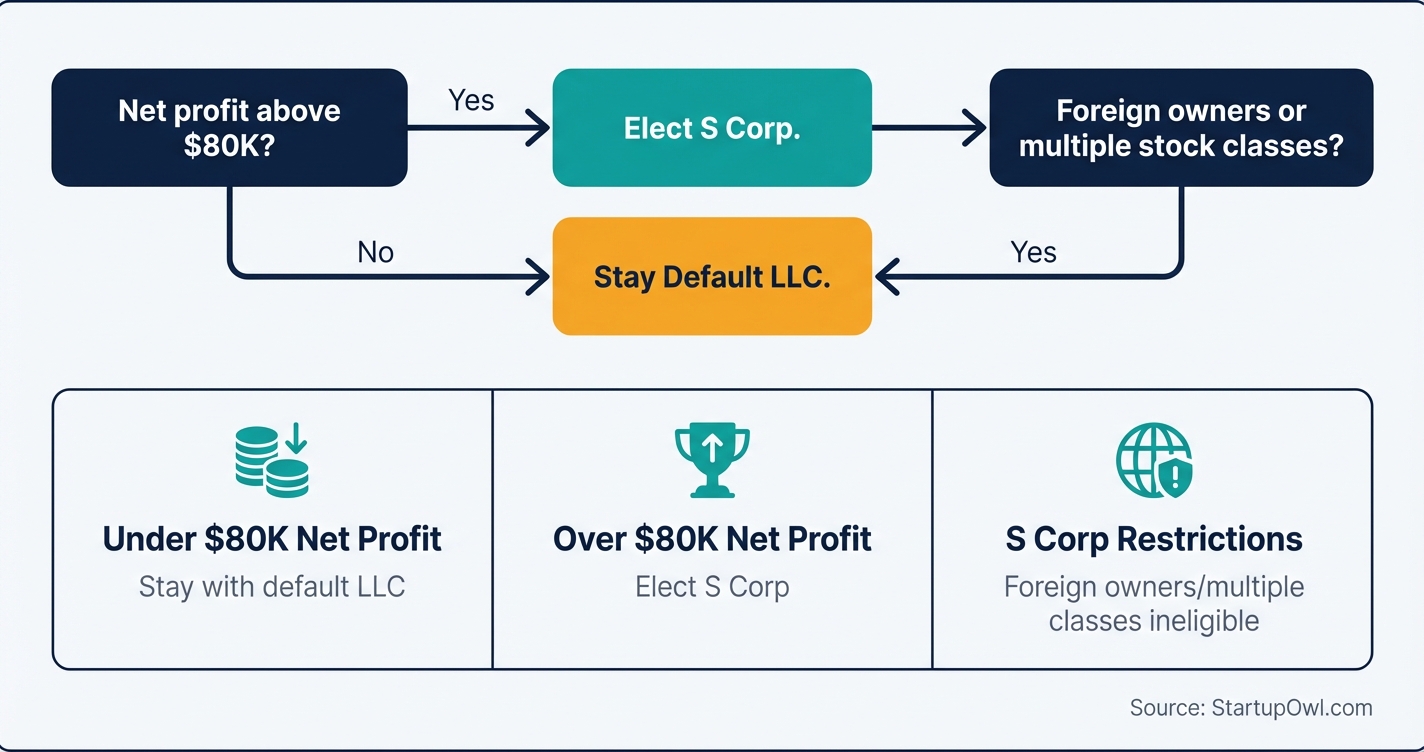
- If your net profit is under $60K, stay with default LLC taxation. S Corp compliance costs will eat any SE tax savings.
- If your net profit is $60K to $80K, the election crosses into profit near $70K. At $80,000 the tax saving is $3,654, so you keep about $1,650 once costs come out. Real, but thin.
- If your net profit exceeds $80K, the election starts to pay properly. At $100,000 you keep about $4,500 after compliance costs.
- If your net profit exceeds $150K, you keep about $10,000 at $150,000 and about $15,500 at $200,000, after costs. Here the election clearly wins.
- If you have foreign owners or want multiple equity classes, S Corp is not an option. Stick with default LLC (or consider C Corp vs S Corp for venture-funded businesses).
- If you are a freelancer just starting out, begin with a default LLC for simplicity. You can elect S Corp later when income justifies it. See our LLC for freelancers guide for specifics.
Not sure which entity type fits at all? Start with our complete guide to business entity types or compare an LLC versus a sole proprietorship first.
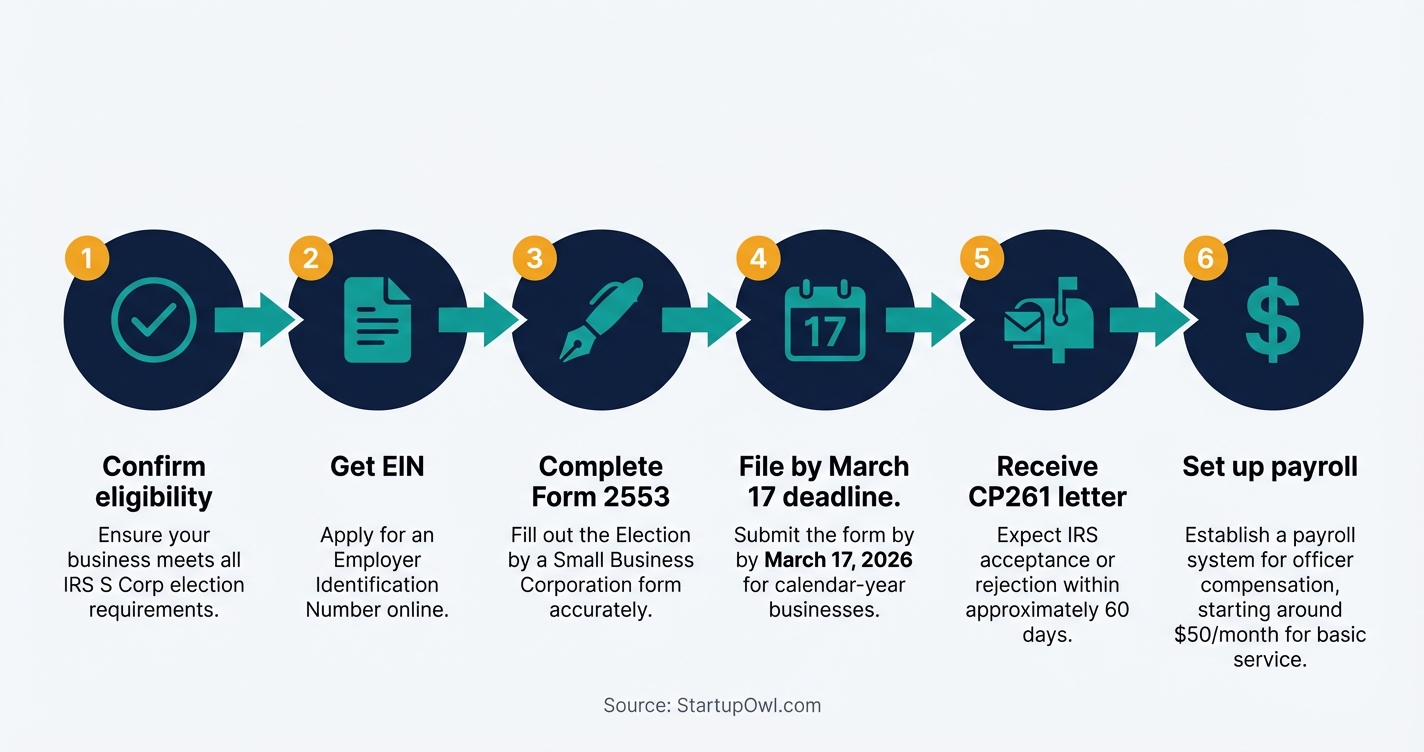
Converting your LLC to S Corp taxation is a one-time IRS filing. You do not need to create a new entity or change anything with your state.
Step 1. Confirm You Meet S Corp Eligibility
Your LLC must be a domestic entity with 100 or fewer shareholders, all of whom are U.S. citizens or residents. You can have only one class of stock (though voting rights may differ). Certain entities like insurance companies or DISCs are ineligible.
Step 2. Get an EIN (If You Do Not Have One)
Apply free at IRS.gov/EIN. It takes under 15 minutes and costs $0. See our EIN application guide for a walkthrough.
Step 3. Complete and File Form 2553
Download Form 2553 from IRS.gov. All shareholders must sign in Column K. The form must be mailed or faxed (the IRS does not accept electronic filing for Form 2553 as of 2026). Faxing is faster and gives you an immediate confirmation.
Step 4. Meet the Deadline
For calendar-year businesses, Form 2553 must be filed within 2 months and 15 days of the start of the tax year. For an election covering 2027 that deadline is March 15, 2027. A date landing on a weekend or a District of Columbia holiday moves to the next business day, which is why the 2026 date was March 16. New businesses get 2 months and 15 days from their formation date.
Step 5. Wait for Confirmation
The IRS sends a CP261 acceptance letter within approximately 60 days. If you have not heard back, call the IRS Business and Specialty Tax Line at (800) 829-4933. Keep your fax confirmation or certified mail receipt as proof of timely filing.
Step 6. Set Up Payroll and Compliance
Once approved, you must run payroll for yourself and any other owner-employees. A basic payroll service runs about $55 a month for one owner-employee, going by Gusto Simple at $49 a month plus $6 per person, read at gusto.com on 25 August 2026. You will also need to file Form 1120-S annually and issue W-2s and K-1s. The National Society of Accountants puts the average Form 1120-S fee at $903, from a survey covering the 2020 and 2021 seasons, so expect to pay more than that now.
Missed the Deadline?
Late election relief exists under Rev. Proc. 2013-30. You can file up to 3 years and 75 days late with a reasonable cause statement. Write "FILED PURSUANT TO REV. PROC. 2013-30" at the top of your Form 2553.
1. Electing S Corp Too Early
If your net profit is under $60,000, S Corp compliance costs (payroll, 1120-S, bookkeeping) will eat most of your tax savings. Run the numbers first. Break-even sits near $70,000 in net profit, and higher if you pay for bookkeeping or your state taxes S Corps separately, as California does.
2. Setting Your Salary Too Low
The IRS requires S Corp shareholders who perform services to take a reasonable salary. Paying yourself $10,000 while taking $200,000 in distributions is a red flag. The IRS reclassified a CPA's distributions after he paid himself just $24,000 on $220,000+ in income. Penalties can include back payroll taxes plus 20% accuracy penalties and interest.
3. Missing the Filing Deadline
The deadline for calendar-year businesses is 2 months and 15 days after the tax year starts, March 15, 2027 for a 2027 election. Miss it and you either wait until next year or file a late election under Rev. Proc. 2013-30 with a reasonable cause statement. Faxing Form 2553 (rather than mailing) gives you an immediate delivery confirmation.
4. Forgetting State-Level Implications
Some states have their own S Corp requirements or do not recognize the federal S election. California LLCs still owe the $800 annual franchise tax regardless of S Corp status. Check your state's rules before filing.
5. Not Running Payroll Properly
An S Corp election means you are an employee of your own LLC. You need W-2s, quarterly 941 filings, and proper withholding. A basic payroll service runs about $660 a year for one owner-employee, going by Gusto Simple at $49 a month plus $6 per person, read at gusto.com on 25 August 2026. Skipping payroll can trigger IRS penalties and potentially revoke your S Corp status.
6. Ignoring the QBI Interaction
The Section 199A Qualified Business Income deduction allows up to 20% off qualifying business income. For higher-income S Corp owners (above $201,750 single / $403,500 married filing jointly for 2026), the QBI deduction may be limited by W-2 wages. Setting your salary too low can reduce your QBI deduction and partially offset your SE tax savings.
7. Forgetting What the Salary Does to Your Health Subsidy
If you buy your own coverage on the marketplace, the salary decision reaches that too. The link is easy to miss. Premiums only produce an above the line deduction when the corporation pays them and reports them on your W-2. That deduction lowers your adjusted gross income, and the marketplace reads that figure. Set the salary low and you cap the deduction. For 2026 the premium tax credit ends above 400 percent of the federal poverty line, $62,600 for one person. See health insurance for LLC owners.
Frequently Asked Questions
Sources & References
- IRS: Self-Employment Tax (Social Security and Medicare Taxes)
- IRS: About Form 2553, Election by a Small Business Corporation
- IRS: Instructions for Form 2553
- SBA: Choose a Business Structure
- California Franchise Tax Board: LLC Information
- Social Security Administration: 2026 Wage Base Announcement
- Cornell Law LII: IRC Section 1362 (S Corporation Election)
Was this article helpful?
Questions about this guide
No comments yet. Ask the first question and a member of our team will answer.
Leave a comment