
Pre-Seed Funding Explained, How Much to Raise and How to Find Investors
Median pre-seed SAFE valuation caps ran $10M to $35M by round size in Q2 2026. What Carta's data means for your raise, your dilution and your terms.

In This Article
- Key Takeaways
- Step-by-Step
- Cost Breakdown
- What Pre-Seed Funding Is and When You Need It
- What Investors Look for at the Pre-Seed Stage
- How to Raise a Pre-Seed Round Step by Step
- The Real Cost of Pre-Seed Funding (It's Equity, Not Interest)
- Top Pre-Seed Investors, Accelerators, and Platforms
- Alternatives If Pre-Seed Equity Isn't Right for You
- 5 Pre-Seed Mistakes That Can Sink Your Startup
- FAQ
$0–$5,000
Est. Cost
90 days
Timeline
5
Total Steps
Pre-seed funding is the earliest equity capital your startup can raise from outside investors. It is not a loan. Carta's Q2 2026 pre-seed data puts the average instrument at $276,000, and a single round often stacks several of them. You give up equity instead of paying interest, and the valuation cap decides how much.
If you're exploring debt-based options instead, check out our guides to business loans for startups or SBA microloans. Both are debt. You repay them on a schedule whether the product works or not, and neither costs you a share of the company.
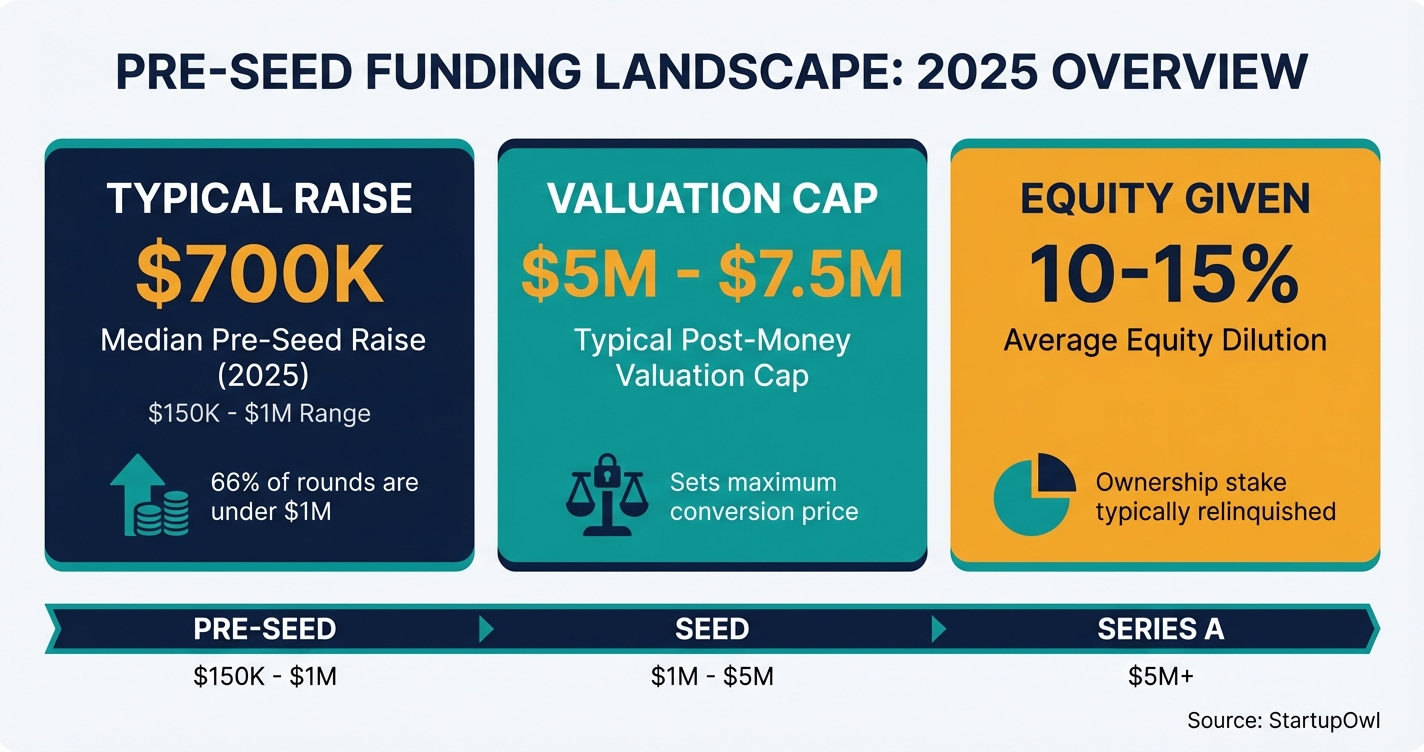
This guide covers how much to raise, what investors expect, how SAFEs and convertible notes work, where to find capital, and the mistakes that sink first-time founders. Start with the cap table below.
Once revenue flows, revenue based financing is the route that costs no equity. Price it first.
What Pre-Seed Funding Is and When You Need It
Pre-seed is the stage between bootstrapping and a formal seed round. You typically have an idea, a founding team, and at most a prototype. You're usually pre-revenue. The capital goes toward building an MVP, hiring your first 1-2 key people, and generating the traction data you'll need to raise a seed round later.
Carta reports pre-seed by instrument, meaning each individual SAFE or note, not by round. In Q2 2026 the average instrument was $276,000, across more than 11,500 instruments and $3.19 billion invested. Few deals clear $2.5M. The ones that do usually stack ten or more instruments together, which is why a median pre-seed round size is not a figure Carta publishes.
What Carta does publish by round size is the valuation cap. That number sets your dilution.
| Round size | Median post-money SAFE cap, Q2 2026 | Dilution at the top of the band |
|---|---|---|
| Under $250K | $10M | 2.5% |
| $250K to $499K | $12M | 4.2% |
| $500K to $999K | $12.5M | 8.0% |
| $1M to $2.4M | $18M | 13.3% |
| $2.5M and above | $35M | Rounds this size stack ten or more instruments |
Median (P50) valuation caps on post-money SAFEs by round size, Carta, Q2 2026. The dilution column divides the top of each band by that median cap. Treat it as a floor. If a later priced round values the company below your cap, those SAFEs convert at the lower number and your investors take more.
Every band rose year over year. The standard instrument is a SAFE (Simple Agreement for Future Equity), which carried 93% of pre-seed rounds in Q2 2026, and 95% of the money raised.
Think of pre-seed as buying 12-18 months of runway to hit the milestones that make your seed round possible: a working product, early paying customers, and measurable growth. The bar is rising. Carta counted 11,500 pre-seed instruments in Q2 2026 against 14,825 a year earlier on almost identical total dollars, so the same money is now reaching fewer companies.
What Investors Look for at the Pre-Seed Stage
There are no legal minimums (no credit score, no revenue threshold, no time-in-business requirement) for pre-seed equity. Investors are betting on your team and your idea, not your financial history. That said, the bar has risen. In 2026, investors increasingly expect a functional product or prototype rather than just a slide deck.
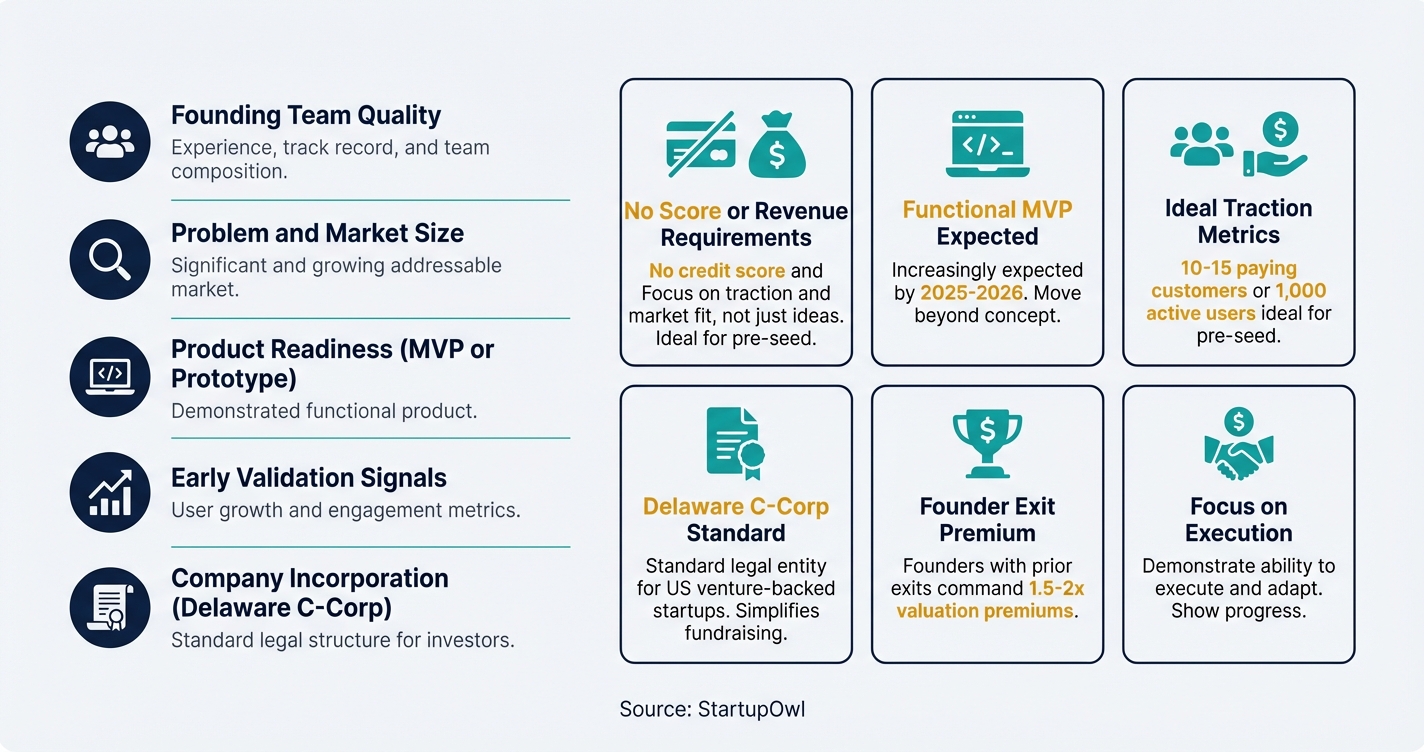
Here's what most pre-seed investors evaluate:
- Founding team quality. Relevant domain expertise, complementary skills across co-founders, and evidence you can execute. Founders with previous exits can command 1.5-2x valuation premiums.
- Problem and market size. A clear, specific problem affecting a large addressable market. Bottom-up TAM calculations (real customer counts, realistic adoption rates) outperform broad analyst claims.
- Product readiness. An MVP, clickable prototype, or at minimum a working demo. Pre-revenue is fine, but you need proof that your target market is interested.
- Early validation signals. Waitlists, signed LOIs, pilot customers, beta users, or 10-15 paying customers. Any evidence that people want what you're building.
- Incorporation. Your company should be officially filed (most U.S. investors require a Delaware C-Corp). Review LLC formation options if you haven't incorporated yet.
You do not need revenue, a business credit score, or a personal guarantee. This is fundamentally different from getting a business loan.
How to Raise a Pre-Seed Round Step by Step
The pre-seed fundraising process has five core stages: preparation, investor targeting, pitching, term negotiation, and closing. Most founders complete the entire process in 2-3 months. You'll pitch your deck 30-50 times before you're done, closing with 8-15 investors who write individual checks of $25K-$250K.
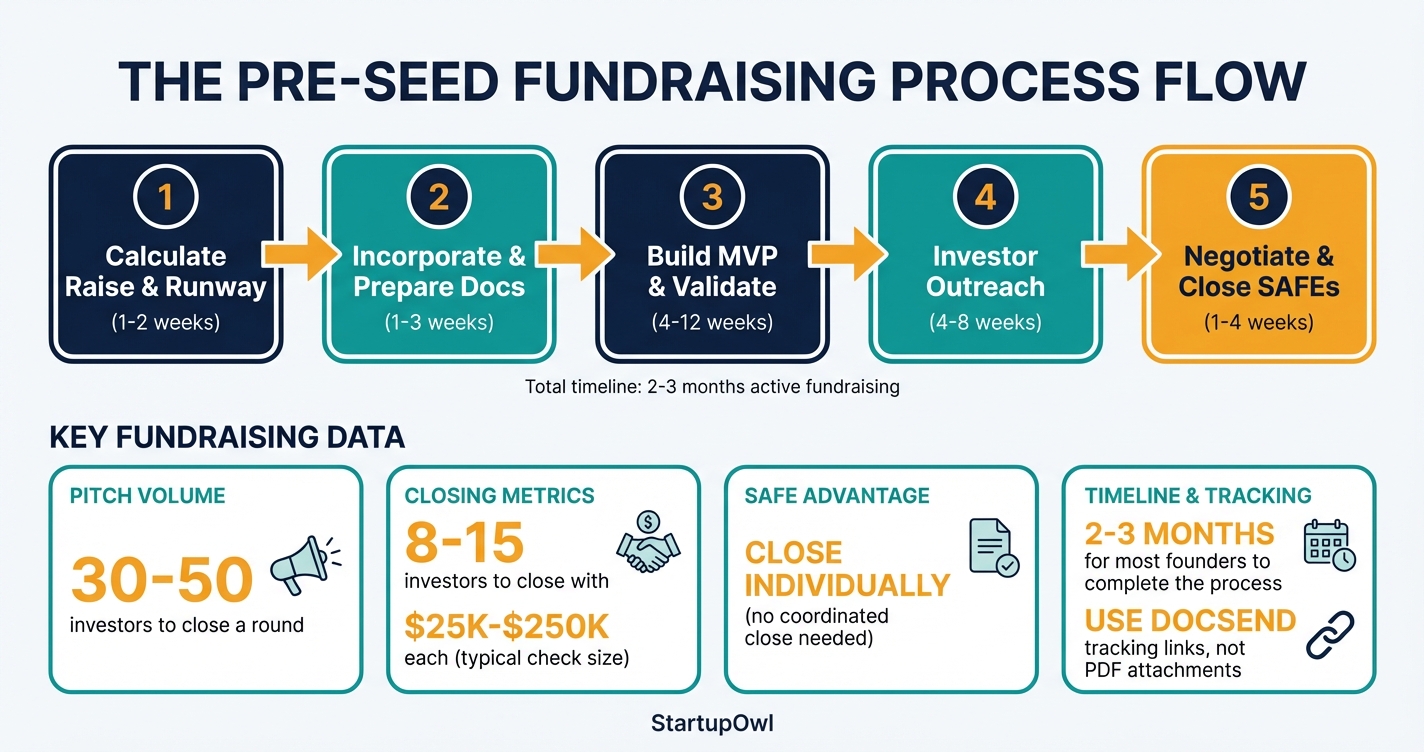
Start by calculating your raise amount using a bottom-up budget. List every milestone you need to hit in the next 12-18 months, estimate costs line by line, and add a 15-25% buffer. Then download Y Combinator's free SAFE templates so you have clean legal docs ready before your first investor meeting.
Build a target list of investors who match your vertical, stage, and check size. Use AngelList to find active angels and syndicates, and apply to accelerators like Y Combinator and Techstars if you want structured mentorship alongside capital. Send your pitch deck as a tracked DocSend link, not a PDF, so you can see which slides investors spend time on.
Once an investor says yes, you negotiate one key number: the valuation cap on your SAFE. Close individually (SAFEs let you wire money as soon as both parties sign) and keep running your process until you hit your target raise. This high-resolution approach is one of the biggest advantages SAFEs offer over priced equity rounds.
The Real Cost of Pre-Seed Funding (It's Equity, Not Interest)
Pre-seed funding has no APR, no monthly payments, and no interest rate. The cost is equity dilution, and it is permanent. Raise $700,000 at the $12.5M median cap for that band and you have sold 5.6% of the company. Raise the same $700,000 at a $7M cap and you have sold 10%. The cap is the whole negotiation.
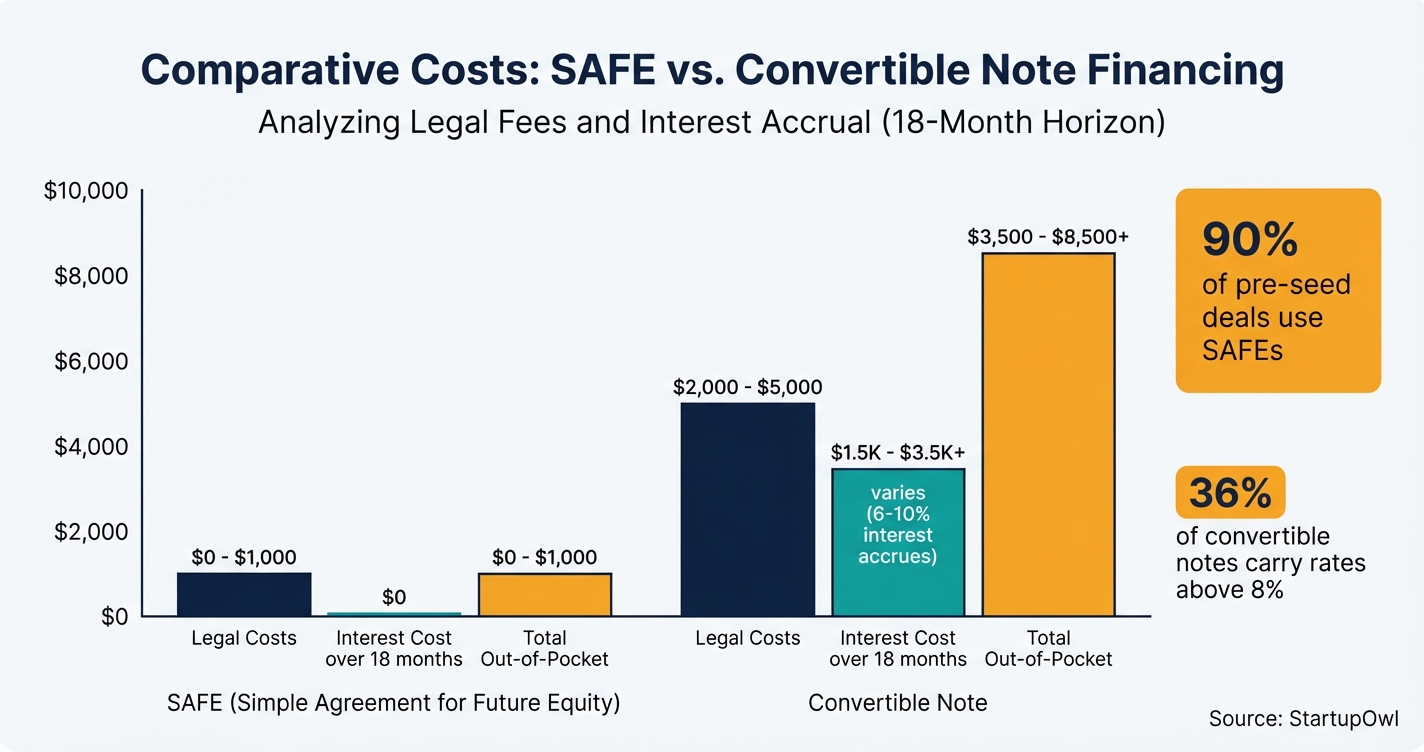
Your out-of-pocket expenses are minimal. Budget $500-$1,500 for incorporation, $1,000-$3,000 for legal review of SAFEs and cap-table modeling, and optionally $0-$2,000 for pitch-deck design. The YC SAFE is a free, one-page document that requires negotiation on just one item, the valuation cap, which saves both sides thousands in legal fees compared to priced rounds.
If you use a convertible note instead of a SAFE, you'll also face an interest rate of 6-10% that accrues until conversion, plus a maturity date (typically 18-24 months) that creates a legal obligation if you haven't raised a priced round by then. Notes are now rare. They carried 7% of pre-seed rounds in Q2 2026 and 5% of the money raised, both record lows on Carta's series.
Track your cumulative dilution carefully. Each SAFE you sign chips away at founder ownership. If you stack multiple SAFEs at different caps without running the math, you can give away far more of the company than any single number above suggests.
SAFE vs. Convertible Note at the Pre-Seed Stage
| Type / Provider | Rate | Notes |
|---|---|---|
| Market Share (Pre-Seed, 2026) | SAFE: 93% | Conv. Note: ~7% | Carta, Q2 2026. Measured by capital raised rather than deal count, the SAFE share is 95%. |
| Interest Rate | SAFE: None | Conv. Note: 6-10% | A note accrues interest until it converts. A SAFE never does. |
| Maturity Date | SAFE: None | Conv. Note: 18-24 months | Convertible notes create a legal repayment obligation at maturity. |
| Typical Valuation Cap | $10M-$35M | Carta, Q2 2026 median by round size, $10M on rounds under $250K rising to $35M on rounds above $2.5M. |
| Typical Discount Rate | 10-20% (if included) | Carta, H1 2026: 73% of post-money SAFEs carried a cap alone, 21% carried both a cap and a discount. |
| Legal Costs | SAFE: $0-$1,000 | Conv. Note: $2,000-$5,000 | SAFEs use a free template. Conv. notes require more negotiation. |
| Conversion Trigger | Next priced round (any size for SAFE; usually $1M+ for conv. note) | SAFEs convert in any priced round. Conv. notes may require a minimum raise. |
Top Pre-Seed Investors, Accelerators, and Platforms
Pre-seed capital flows from three main channels: angel investors, accelerators, and dedicated pre-seed funds. Here are the most active options as of August 2026:
- Y Combinator invests $500,000 in every accepted company ($125K on a 7% SAFE plus $375K on an uncapped MFN SAFE). YC runs four batches per year and accepts startups at the idea stage (about 40% of each batch has no product yet). The network, mentorship, and Demo Day investor exposure are the primary value-adds beyond capital.
- Techstars invests $220,000 per company ($200K uncapped MFN SAFE + $20K for 5% common equity via a CEA). Techstars runs 3-month accelerator programs in multiple cities and verticals. Alumni companies have raised over $30 billion in lifetime capital, and 74% raise follow-on funding within 3 years.
- AngelList is the default platform for raising from angels and syndicates. Over $3.5 billion has been invested into 7,000+ startups via the platform, with 200+ reaching unicorn status. Roll-Up Vehicles consolidate multiple angel checks into one cap-table line.
- Precursor Ventures focuses on backing founders early, investing up to $500K in pre-seed rounds. They invest in people over products and are one of the most recognized dedicated pre-seed funds.
- Bee Partners leads pre-seed rounds of $250K-$1M for SaaS and data-first startups, providing go-to-market playbooks and founder-to-founder learning networks. Portfolio includes companies like Klaviyo and PathAI.
For a broader search, explore our angel investors guide and small business grants (grants don't require equity).
Should You Apply to an Accelerator or Raise Independently
Accelerators like YC and Techstars offer capital, mentorship, and investor access in a single package. The price is equity. They take 5-7%, which is meaningful at the earliest stage. If you already have warm investor connections and don't need structured mentorship, raising independently on SAFEs may preserve more ownership. If you lack a network, an accelerator's Demo Day and alumni community can be worth several multiples of the equity cost.
Alternatives If Pre-Seed Equity Isn't Right for You
Not every founder wants to (or should) give up equity at the earliest stage. Here are alternatives to consider:
- Bootstrapping (self-funding). If you can build an MVP on your own savings, you retain 100% ownership. Many SaaS founders ship a product with under $10,000 using no-code tools. The trade-off is slower growth and no investor network.
- Small business grants. Free money that doesn't require equity or repayment. Grants from the SBA, state agencies, and industry-specific programs typically range from $5,000 to $50,000. Highly competitive but worth applying to.
- Microloans. If you have a revenue-generating idea (like a service business), microloans from SBA-approved intermediaries provide up to $50,000 at rates around 8-13% without giving up equity.
- Business credit cards. Useful for covering small expenses ($5,000-$25,000) while you build. Not a substitute for a real raise, but can bridge short-term cash needs.
- Revenue-based financing. Also called "seed strapping." You grow using customer revenue plus minimal outside capital. This approach is gaining traction in 2026 as traditional VC fundraising gets harder for non-AI startups.
If your startup is a lifestyle business or local service company (not targeting venture-scale growth), equity funding is probably not the right fit. Consider a working capital loan or business line of credit instead.
5 Pre-Seed Mistakes That Can Sink Your Startup
1. Raising at a cap your seed round cannot clear. A valuation cap is a promise that the company will be worth more later. Set it far above what a seed investor will pay and your early backers face a down round, which destroys trust and morale. The market gives you a reference point. Carta's Q2 2026 medians run $10M to $12.5M on rounds under $1M, so a cap several times that on a pre-revenue company needs traction behind it, not optimism.
2. Stacking too many SAFEs without modeling dilution. Post-money SAFEs are deceptively simple. If you issue $200K here, $300K there, $500K over there at different caps, you can unknowingly give away 25%+ of your company before your first priced round. Run a pro-forma cap table after every SAFE you sign.
3. Spending the raise on the wrong things. Pre-seed capital should go to product development, early customer acquisition, and key hires. Spending on fancy offices, expensive branding, or conference sponsorships burns runway without hitting investor milestones. Every dollar should connect to a metric investors care about.
4. Skipping founder vesting agreements. If one co-founder leaves six months in, you don't want them walking away with 25%+ of the company. A standard 4-year vesting schedule with a 1-year cliff protects all founders and reassures investors.
5. Not building investor relationships before you need money. The best pre-seed investors fund people they know. Start networking, sharing progress updates, and asking for advice 3-6 months before you plan to raise. Warm beats cold, every time.
Step-by-Step Process
- 1
Calculate your target raise and runway
Start with your monthly burn rate and multiply it by 12-18 months to find a baseline raise target. Add a 15-25% contingency buffer on top. Most pre-seed startups budget between $150K and $500K for core team salaries, product development, initial customer validation, and overhead.
Your raise amount determines the cap you negotiate. Carta's Q2 2026 medians by round size were $10M under $250K, $12M from $250K to $499K, and $12.5M from $500K to $999K. Raise $700K at a $12.5M cap and you sell 5.6% of the company. That is the trade.
Tips
- List every milestone (MVP launch, first 10 paying customers, key hires) and assign a dollar cost to each before setting your raise target.
- Use a bottom-up budget, not a top-down guess. Line-item your salaries, hosting, legal fees, and marketing spend month by month.
- Keep founder salaries modest ($50K-$80K annually) to stretch runway and signal discipline to investors.
Common Mistakes
- Raising too little and running out of cash before hitting the milestones needed for a seed round.
- Setting your valuation cap too high, which scares off angels and makes your seed round harder to price.
- 2
Incorporate your company and prepare legal documents
Most pre-seed investors require you to be incorporated as a Delaware C-Corp. If you haven't formed your entity yet, check out our guide to LLC formation or review the LLC vs S Corp comparison to pick the right structure (though C-Corps are standard for venture-backed startups).
Download the free YC SAFE templates so you have clean documents ready to share with potential investors. Prepare a data room with your incorporation docs, founder agreements, IP assignment agreements, and a pro-forma cap table.
Tips
- Use post-money SAFEs (the current standard for 85%+ of the market) so both you and investors can immediately see dilution percentages.
- Get a startup lawyer to review your docs for $1,000-$2,000 rather than using a general-practice attorney.
Common Mistakes
- Issuing SAFEs without tracking cumulative dilution across multiple investors, which can leave founders with less than 60% equity before a seed round.
- 3
Build your MVP or prototype and gather early validation
Investors at the pre-seed stage increasingly expect a functional product rather than a slide deck alone. Your goal is to prove that your target market wants what you're building, even if you're pre-revenue. Aim for at least one tangible validation signal: 10-15 paying customers, 1,000 active users, a waitlist with 200+ signups, or signed letters of intent.
In 2026, no-code tools and AI-powered development platforms lowered the cost of launching an MVP significantly. Software startups can often build a working prototype for under $10,000. Hardware or biotech startups should expect higher costs and may need to target the upper end of pre-seed ranges ($500K-$1M+).
Tips
- Document every conversation with potential customers. Investor pitch decks with real quotes or user counts outperform vision-only decks.
- Pre-seed decks typically have 10-12 slides. Focus on problem clarity, solution uniqueness, and your team's relevant expertise.
- Track your metrics from day one. Even small numbers (50 beta users, 3 pilot customers) beat zero.
Common Mistakes
- Spending 6+ months perfecting the product before talking to investors. Start building relationships early, even before your MVP is done.
- Using top-down TAM numbers ($50B market!) without showing a realistic bottom-up calculation of how you'll capture initial customers.
- 4
Build your investor target list and begin outreach
Pre-seed capital typically comes from three sources: friends and family, angel investors (individual checks of $25K-$250K), and pre-seed funds or accelerators. Platforms like AngelList help you consolidate multiple smaller angel checks into a single cap-table line, saving $8K+ in legal fees compared to managing them individually.
Plan to pitch 30-50 investors to close your round. Most founders complete a pre-seed raise in 2-3 months. Start with warm introductions from your network; cold outreach has a low response rate. Research each investor's portfolio, check size, and thesis before reaching out.
Tips
- Target investors who have backed companies in your industry vertical. A relevant investor brings introductions, not just capital.
- Use DocSend links (not PDF attachments) for your pitch deck so you can track who opens it and which slides they spend time on.
Common Mistakes
- Blasting your pitch deck to 200 investors at once instead of running a focused, batch-based outreach strategy with warm intros first.
- 5
Negotiate terms, sign SAFEs, and close the round
The primary term you'll negotiate is the valuation cap on your SAFE. Carta's Q2 2026 medians ran from $10M on rounds under $250K to $35M on rounds above $2.5M, and every band rose year over year. Avoid stacking a cap and a discount on one SAFE. Most founders do not. In the first half of 2026, 73% of post-money SAFEs carried a cap alone, and 21% carried both.
Once an investor agrees to terms, you can close individually and wire money immediately (that's the speed advantage of SAFEs over priced rounds). Run the math each time. At those median caps, a raise of $150K to $1M sells roughly 1.5% to 8% of the company, and signing SAFEs at several different caps pushes the total higher than most founders expect.
Tips
- Run a pro-forma cap table showing dilution from every SAFE before you sign. Post-money SAFEs make this calculation straightforward.
- Limit yourself to 2-3 tranches of SAFEs maximum (pre-seed, seed, and possibly a pre-A bridge) to keep your cap table clean.
Common Mistakes
- Stacking too many SAFEs at different caps without modeling the cumulative dilution. Some founders give up 25%+ before their first priced round.
- Agreeing to side letters with special investor rights that undermine the simplicity of your SAFE structure.
Cost Breakdown
| Item | Cost Range | Notes |
|---|---|---|
| Delaware C-Corp Incorporation | $500-$1,500 | Standard requirement for venture-backed startups. Includes state filing fees and registered agent. |
| Startup Legal Fees (SAFE Review) | $1,000-$3,000 | Lawyer review of SAFE documents, cap table modeling, and data room prep. Using YC's free SAFE templates reduces this. |
| Pitch Deck Design (Optional) | $0-$2,000 | DIY with free tools or hire a specialist. Most pre-seed founders build their own 10-12 slide deck. |
| AngelList Roll-Up Vehicle | $8,000 | Optional. Consolidates multiple angel checks into one cap-table entry. Worth it if you have 10+ small-check investors. |
| Total Direct Costs to Founders | $500-$5,000 | Excludes the equity you give away, which at Carta's Q2 2026 median caps runs about 1.5% to 8% on a $150K to $1M raise. No APR or interest because pre-seed is equity, not debt. |
Frequently Asked Questions
Work it out from your burn rate. There is no reliable median to copy, because Carta counts individual SAFEs rather than rounds. Multiply your monthly burn by 12-18 months and add a 15-25% buffer. Software startups typically land between $200K and $500K, while hardware and biotech founders often need $500K-$1M+.
A SAFE (Simple Agreement for Future Equity) is a one-page investment contract created by Y Combinator in 2013. It gives the investor the right to receive equity when you raise a priced round (usually a Series A). You negotiate just one number (the valuation cap), and there is no interest rate, maturity date, or repayment obligation. Carta put SAFEs at 93% of pre-seed rounds in Q2 2026, and 95% of the money raised. Notes are now rare.
Less than most guides say. At Carta's Q2 2026 median valuation caps, a raise of $150K to $1M sells roughly 1.5% to 8% of the company. The arithmetic is the investment divided by the cap, so $700K at the $12.5M median for that band is 5.6%. Two things push it higher, signing several SAFEs at different caps, and a later priced round that values you below your cap.
No. Most pre-seed startups are pre-revenue. Investors at this stage are evaluating your team, market opportunity, and product potential. That said, any traction signal helps: 10-15 paying customers, a waitlist, LOIs, or active beta users. Even small proof of demand significantly strengthens your pitch.
The instrument is the clearest difference. Pre-seed almost always runs on a SAFE, 93% of rounds in Q2 2026, while a seed round is usually priced equity with a full term sheet. On price, Carta's median pre-seed valuation cap in Q2 2026 ran from $10M on rounds under $250K to $35M on rounds above $2.5M. Pre-seed money buys the move from idea to MVP. Seed money buys early scaling once you have product-market fit signals.
Most founders complete their pre-seed raise in 2-3 months of active fundraising. Plan to pitch 30-50 investors during that period. Using SAFEs speeds up closing because you can sign and wire with each investor individually instead of waiting for a single coordinated close.
For most pre-seed raises, a SAFE is the better choice. It has no interest rate, no maturity date, and minimal legal costs (the template is free from Y Combinator). Convertible notes carry 6-10% interest and a maturity deadline of 18-24 months. Use a convertible note only if your investors specifically require one or you're in a geography where SAFEs are less common.
This content is for informational purposes only and does not constitute financial, legal, or tax advice. Pre-seed funding terms, valuations, and dilution vary by investor, geography, and business characteristics. Consult a licensed financial advisor, CPA, or startup attorney before making fundraising decisions. Market data reflects industry benchmarks as of August 2026 and may change without notice.
Sources & References
- State of Pre-Seed: Q2 2026 - Carta
- In the pre-seed market, valuation caps on new SAFEs keep getting bigger - Carta
- What Is a SAFE? (Simple Agreement for Future Equity) - Carta
- YC Safe Financing Documents - Y Combinator
- The Y Combinator Standard Deal
- Techstars Investment Terms Update
- A Guide to Seed Fundraising - Y Combinator
- Pre-Seed Valuations in 2026: What Founders Need to Know - Zeni
- SAFE vs Convertible Note: Complete Comparison (2026) - Promise Legal
- Key Terms: SAFEs & Convertible Notes for Pre-seed Funding - SPZ Legal
- AngelList - Startup Investment Platform
Was this article helpful?
Questions about Pre-Seed Funding Explained, How Much to Raise and How to Find Investors
6 comments
stealth_hw
August 23, 2026
how long does pre seed fundraising realistically take start to close, building hardware so timing matters
Richard MooreGeekdiys team
Senior Finance & Banking Editor · August 23, 2026
Software founders typically see 2 to 4 months from first pitch to money in the bank. Hardware runs longer, fewer investors touch it, so start earlier than feels natural and keep building in public while you raise, momentum is the best diligence answer.
Farrah
July 16, 2026
how much equity is normal to give up this early? terrified of handing over too much before there is anything real
Richard MooreGeekdiys team
Senior Finance & Banking Editor · July 17, 2026
The common band is 10 to 20 percent for the whole round, whatever the instrument. Above that this early and the cap table starts scaring the next round's investors, which hurts everyone including the angel who over took.
jjchen
July 8, 2026
how much do pre seed rounds actually run, seeing wildly different numbers
Richard MooreGeekdiys team
Senior Finance & Banking Editor · July 10, 2026
Wide because the stage is wide, friends and family checks in the tens of thousands up to institutional pre seed rounds well past a million. The article's ranges hold, the useful move is anchoring on months of runway you need, not on what other startups raised.
Leave a comment