How to Start an E-Commerce Business
Every guide to starting an online store repeats that 80% of them fail within 120 days. Nobody has ever produced a source for that number.
In This Article
- Overview
- Business Snapshot
- Introduction
- Sub-Niches
- Research the Market and Validate Demand for Your Product
- Write a Lean Business Plan That Includes Unit Economics
- Cost Breakdown
- Choose Your Business Structure for Liability Protection
- Register Your Business and Get Your EIN
- Get Licensed and Register for Sales Tax
- Licenses & Permits
- Source Your Products and Set Up Inventory
- Day-1 Equipment
- Set Your Pricing for Profitable Unit Economics
- Get Business Insurance Before Your First Sale
- Mistakes to Avoid
- Build Your Online Store and Optimize for Conversions
- Land Your First Customers With Targeted Ads and Outreach
- Marketing Channels
- Set Up Accounting and Understand Your Tax Obligations
- Build Your Online Presence and Stay Compliant Year-Round
- Is This Right for You?
- Top Challenges
- Tools & Equipment
- How to Find Clients
- Marketing
- Copy-and-Use Templates
- Scaling Your Business
- Helpful Resources
- Taxes & Structure
- Insurance
- State Variations
- FAQ
- Next Steps
What This Guide Covers
This guide walks you through every step to start an e-commerce business, from validating your idea to choosing the right legal structure, getting licensed, and reaching your first customers. Updated for 2026.
Business Snapshot
- Startup Cost Range
- $500–$20,000
- Avg. Annual Revenue
- $64,084 (no employees)
- Profit Margin
- 10% - 25%
- Time to Launch
- 2-8 weeks
- Break-Even Timeline
- 6-18 months
- Avg. Owner Salary
- Not federally tracked
- Avg. Insurance Cost
- $500 - $1,400/year
- Monthly Operating Cost
- $500 - $4,000/month
- Pricing Model
- Per unit
- Market Growth Rate
- 8% over the prior twelve months
- Year-1 Failure Rate
- 15.6% of new retail businesses close in year one (BLS)
- Marketing Budget
- $500 - $2,000/month first year
- Recommended Entity
- LLC
- Market Size
- $1.30 trillion US online sales (12 months to June 2026)
- Last Updated
- August 30, 2026
Industry Trend
Americans spent $329.5 billion online in the second quarter of 2026, 12.4% more than in the same quarter of 2025, and that was 16.4% of everything they spent at retail. The source is the Census Bureau. Its August 18 release covers the second quarter, which is the most recent one the government has published. Online sales are growing at roughly twice the pace of retail as a whole, which rose 6.6% over the same period, so the share of spending that happens online keeps climbing.
Cost ranges from a lean dropshipping setup (under $500) to a private-label inventory model requiring $5,000 to $20,000 for product sourcing, branding, and initial marketing.
What It Actually Takes to Build a Profitable Online Store
Every guide to starting an online store repeats that 80% of them fail within 120 days. Nobody has ever produced a source for that number. What the federal government does publish is that Americans spent $1.30 trillion online in the twelve months to June 2026, and that 84.4% of new retail businesses were still trading a year after they opened. This guide runs on those numbers.
You can launch a basic Shopify or WooCommerce store for under $500 if you use a dropshipping or print-on-demand model. A private-label or inventory-held store typically requires $5,000 to $20,000 upfront for product sourcing, branding, and initial ad spend.
The average net profit margin across e-commerce sits around 10%, and top-performing stores hit 20% or higher. Your path to profitability depends on three variables: product margin, customer acquisition cost, and repeat purchase rate. This guide walks you through every step with real numbers so you can model your own break-even timeline before spending a dollar.
One number to ignore before you start. Almost every guide to this business says 80% or 90% of new stores fail within 120 days, and nobody has ever named a source for it. The closest hard federal figure comes from the Bureau of Labor Statistics, which counts retail businesses that have employees. Of those that opened in the year to March 2024, 84.4% were still open twelve months later, and of the ones that opened two years earlier, 68.5% were still open after three years. A one-person store with no payroll sits outside that count, so read it as the optimistic end of the range. It is still nowhere near four in five gone inside four months.
E-Commerce Business Sub-Niches to Explore
Research the Market and Validate Demand for Your Product
Americans spent $1.30 trillion online in the twelve months to June 2026, and sales in the second quarter alone ran 12.4% ahead of the same quarter in 2025, according to the Census Bureau. Demand is not what closes new stores. Poor product-market fit and weak marketing are.
Before you invest a dollar, use Google Trends, Jungle Scout, or Helium 10 to verify that real people are searching for your product category. Model your numbers with a startup cost calculator to see if the math works at your projected price point and margin.
Pro Tip
Search Amazon Best Sellers in your category and read the 2-star and 3-star reviews. Those reviews reveal exactly what customers want improved, and that gap is your product opportunity.
Write a Lean Business Plan That Includes Unit Economics
Your e-commerce business plan does not need to be 40 pages. It needs three things: a clear unit economics model (COGS + shipping + ads per unit vs. selling price), a 12-month cash flow forecast, and a customer acquisition strategy.
If you plan to seek funding or an SBA loan, a formal plan becomes required. Use our business plan guide to build one that investors and lenders actually read. Map out your break-even point before committing to inventory.
Pro Tip
Calculate your break-even on a per-unit basis. If you sell a product for $40, your COGS is $12, shipping is $5, and your blended ad cost per acquisition is $15, your profit per unit is $8. You need 625 sales to cover $5,000 in startup costs.
Startup Cost Breakdown
Itemized estimate for launching an E-Commerce Business. Costs vary by location and whether you hire staff.
| Item | Low Est. | High Est. |
|---|---|---|
| E-Commerce Platform SubscriptionWooCommerce is free; Shopify Basic runs $39/month ($468/year) and BigCommerce starts at the same tier. | $0 | $468 |
| Domain Name and SSL CertificateDomain registration costs $10 to $50/year and an SSL certificate runs $0 to $200/year depending on your host. | $10 | $250 |
| Website Design and ThemeFree themes work for launch; custom design costs $1,000 to $5,000 for a branded storefront. | $0 | $5,000 |
| Initial Inventory or Product SamplesDropshipping requires zero inventory; a private-label first batch typically costs $1,000 to $5,000. | $0 | $5,000 |
| Branding and Logo DesignCanva and Looka handle basics under $50; a professional brand package costs $500 to $2,000. | $50 | $2,000 |
| Business Registration and LicensesLLC filing fees range from $35 to $500 depending on your state. | $35 | $500 |
| First-Year Marketing BudgetAllocate at least $500 for initial paid ads on Google or Meta to test product-market fit. | $500 | $5,000 |
| Software and Tools (Annual)Email marketing, accounting, and analytics tools run $10 to $170/month combined. | $120 | $2,000 |
| Shipping and Fulfillment SetupThird-party fulfillment is quoted per account, no major US 3PL publishes a rate; self-fulfillment needs shipping supplies and storage space. | $0 | $3,000 |
| Total Estimate | $715 | $23,218 |
Product pricing depends on your cost of goods sold, competitive landscape, and fulfillment model. A 50% to 100% markup on COGS is standard for most consumer products, translating to a 30% to 50% gross margin before ad spend.
Choose Your Business Structure for Liability Protection
An LLC is not legally required. Sell without registering and your state treats you as a sole proprietor. The SBA calls that a fair start for low-risk work and for owners still testing an idea. Shipping physical goods is not low risk. That is why an LLC suits most e-commerce sellers. It keeps your own savings clear of product liability claims, customer lawsuits and marketplace disputes, without the paperwork a corporation brings.
Filing costs range from $35 to $500 depending on your state, and the process takes 1 to 3 weeks in most cases. Follow our LLC formation guide for step-by-step instructions specific to your state, or our sole proprietorship and LLC comparison if you are still weighing the two.
Pro Tip
Choose an LLC from day one. You can elect S-Corp tax treatment later once annual profit clears $50,000 and the savings outweigh the payroll admin cost.

Form Your E-Commerce Business LLC with Northwest
An LLC separates your personal assets from product liability claims and marketplace disputes while keeping taxes simple with pass-through treatment.
Register Your Business and Get Your EIN
File your LLC with your state's Secretary of State office. Fees range from $35 to $500 depending on the state, and processing takes 3 to 15 business days.
Your EIN (Employer Identification Number) is free and takes 10 minutes to obtain at IRS.gov. You will need it to open a business bank account and set up payment processing. If your state requires a registered agent, consult our registered agent guide to find an affordable option.
Pro Tip
Apply for your EIN immediately after your LLC is approved. You cannot open a business bank account or apply for a Shopify Payments account without it.
Get Licensed and Register for Sales Tax
E-commerce businesses need several permits depending on your state and product type. Here is what to check:
- General Business License from your city or county ($50 to $400). Check requirements at SBA.gov.
- Sales Tax Permit (Seller's Permit) in your home state and any state where you have sales tax nexus (usually free to $50).
- Home Occupation Permit if you store inventory at home or receive regular carrier pickups.
- DBA Filing if your store name differs from your LLC's legal name ($10 to $100).
- Reseller's Permit if you buy products wholesale for resale, which allows you to skip paying sales tax to your supplier.
Pro Tip
Most states now require e-commerce sellers to collect sales tax once they hit $100,000 in sales or 200 transactions in that state. Set up automated tax collection from day one using Shopify Tax or TaxJar.
Important
Collecting sales tax without a valid permit can result in penalties. Register for your seller's permit before you process your first order.
Licenses & Permits for an E-Commerce Business
Requirements vary by state and city — confirm with your local government before opening.
General Business License
RequiredMost cities and counties require a business license to operate, even for online-only stores. Fees range from $50 to $400.
Apply / Learn MoreSales Tax Permit (Seller's Permit)
RequiredRequired in most states to collect and remit sales tax on tangible goods sold online. Free to $50 in most states.
Apply / Learn MoreEmployer Identification Number (EIN)
RequiredFree from the IRS. Required for LLCs, hiring employees, and opening a business bank account.
Apply / Learn MoreHome Occupation Permit
Required in some cities if you run your e-commerce business from home, especially if you store inventory or receive frequent shipments.
Apply / Learn MoreDBA (Doing Business As) Filing
Needed if you operate under a trade name different from your legal LLC name. Costs $10 to $100 in most states.
Apply / Learn MoreNote
No mandatory certifications exist for general e-commerce, but PCI DSS compliance is required if you handle credit card data directly. Most platforms like Shopify handle PCI compliance on your behalf.
Source Your Products and Set Up Inventory
Your fulfillment model determines your startup cost more than any other decision. Dropshipping requires zero inventory investment. A private-label first batch typically costs $1,000 to $5,000 for 100 to 500 units depending on the product category.
Order product samples from at least 3 suppliers before committing. Sample costs run $10 to $500 per item. Platforms like Alibaba (for manufacturing) and Faire (for wholesale) are standard starting points for sourcing.
Who the importer of record is and when that is you
Buy from an overseas manufacturer and someone has to be the importer of record, the party CBP holds liable for the duty owed and for the accuracy of the paperwork. If you buy the goods and they ship to you, that party is you. Your supplier is not. Your freight forwarder is not.
That means getting an importer number from CBP, which you do on CBP Form 5106. From 18 September 2026 CBP will void that number immediately where the data on the form is wrong or incomplete, with no warning and no window to fix it first. A voided number cannot be used to enter goods at all. Three fields cause most of the trouble.
- Physical address. It has to be where the business actually is. A registered agent, customs broker, freight forwarder, PO box or business service center will not do. Your home address is fine.
- Email address. It has to belong to you, not to your broker. CBP sends the voiding notice to whatever address it holds.
- Phone number. Same rule. It has to be yours.
The rule sits in a CBP notice published on 19 August 2026 at 91 FR 53627. Check what CBP holds for you before the date. Correcting a 5106 takes minutes. Getting a voided number reestablished does not.
Pro Tip
Never order more than 100 units on your first production run. Test the market with a small batch, gather customer feedback, and iterate before committing to a larger order.
Important
Always request a product sample and verify supplier quality before placing a bulk order. A $30 sample can save you from a $3,000 inventory mistake.
Day-1 Equipment for an E-Commerce Business
These are the essentials you need before taking your first job. Prices are estimates — shop used gear to cut startup costs.
Computer or Laptop
$400 - $1,200Any modern laptop handles store management; invest in a second monitor if you process orders daily.
Product Photography Setup
$50 - $500A lightbox ($30 to $80), tripod, and smartphone camera produce professional product shots for launch.
Shipping Supplies
$50 - $300Poly mailers, boxes, tape, and a thermal label printer cover your first 200 orders if you self-fulfill.
Barcode Scanner (if warehousing)
$30 - $150A USB barcode scanner speeds up inventory counts and order picking once you hold 50 or more SKUs.
Label Printer
$100 - $250A DYMO or Rollo thermal label printer eliminates ink costs and prints shipping labels in seconds.
Set Your Pricing for Profitable Unit Economics
A standard e-commerce markup is 50% to 100% over your cost of goods sold, which translates to a 30% to 50% gross profit margin. Your final price must cover COGS, shipping, payment processing fees (2.9% + $0.30 per transaction on most platforms), and your customer acquisition cost.
Research competitor pricing on Amazon, Google Shopping, and direct competitor stores. Price too low and you will run out of margin before you run out of customers. Price too high without brand differentiation and your conversion rate drops to zero.
Pro Tip
Build your price from the bottom up. Start with your landed COGS, add your target ad cost per sale, add platform fees and shipping, then add your desired profit per unit. If the total price is not competitive, fix your costs before dropping your price.
Get Business Insurance Before Your First Sale
E-commerce businesses need general liability insurance (averaging $42/month or $500/year), product liability coverage (often bundled with general liability), and cyber liability insurance to protect against data breaches. A business owner's policy (BOP) bundles general liability and commercial property coverage for roughly $95/month.
Amazon requires qualifying sellers to carry at least $1 million in liability coverage. Even if you sell on your own site, one defective product claim without insurance can end your business. Compare providers through our best business insurance guide.
Pro Tip
Get a BOP (Business Owner's Policy) instead of buying general liability and property coverage separately. It typically costs less and provides broader protection.
Important
Do not take your first client or job without insurance in place. One incident without coverage can end the business before it starts.
Mistakes to Avoid
Spending $3,000 or more on a custom website before validating that anyone will buy the product.
Ignoring customer acquisition cost and scaling ad spend on products with slim margins.
Choosing a product based on personal passion instead of verifiable market demand and search volume.
Skipping sales tax registration and ending up owing back taxes plus penalties in multiple states.
Ordering 500 units of inventory before testing with a small batch of 50 to 100 units.
Relying on a single traffic source like Facebook Ads and losing all revenue when CPMs spike.
Neglecting email list building from day one and paying to re-acquire customers who already bought.
Underpricing products to beat competitors rather than differentiating on brand, packaging, or speed.
Listing a registered agent, mailbox service or freight forwarder address on CBP Form 5106, which CBP can void your importer number over from 18 September 2026.
Build Your Online Store and Optimize for Conversions
Shopify ($39/month for Basic) is the fastest path to a functional store. WooCommerce (free plugin, hosting costs $5 to $30/month) gives you more control if you are comfortable with WordPress. Both platforms handle PCI compliance and integrate with major payment processors.
Your store needs high-quality product photos, clear pricing, trust badges, and a mobile-optimized checkout. The average e-commerce conversion rate is 2.5%, and mobile accounts for 73% of all online shopping sessions. Compare platform options in our website builder guide.
Pro Tip
Install a live chat widget (Tidio or Gorgias) and enable abandoned cart email recovery on day one. Abandoned cart emails recover 5% to 15% of lost sales with zero additional ad spend.
Land Your First Customers With Targeted Ads and Outreach
Your first 50 sales will likely come from a combination of personal network outreach, social media content, and a small paid ad budget. Allocate $300 to $500 for initial Facebook or Google Shopping test campaigns to validate your product and messaging before scaling.
Run 3 to 5 ad creatives simultaneously and kill anything below a 2.0 ROAS within 7 days. Track your customer acquisition cost per sale from the first dollar. If you are selling on marketplaces, set up a CRM to capture customer emails for future direct marketing.
Pro Tip
Send your product to 5 to 10 micro-influencers (1,000 to 10,000 followers) in your niche for honest reviews. One viral post from a trusted creator can generate more sales than $500 in paid ads.
Top Marketing Channels for an E-Commerce Business
Primary
Secondary
Set Up Accounting and Understand Your Tax Obligations
Open a dedicated business bank account immediately (see our best business bank accounts guide). Never mix personal and business funds. Connect your bank account to accounting software like QuickBooks or Wave to track every transaction automatically.
As a self-employed e-commerce owner, you owe 15.3% self-employment tax on net profit plus federal income tax. Quarterly estimated tax payments are due in January, April, June, and September. Key deductions include:
- Cost of goods sold and product samples
- Shipping and fulfillment expenses
- Platform subscription fees and software tools
- Advertising and marketing spend
- Home office deduction (if applicable)
Pro Tip
Set aside 25% to 30% of every dollar of profit for taxes from the start. Missing a quarterly payment triggers penalties, and the IRS charges interest on the unpaid balance.
Build Your Online Presence and Stay Compliant Year-Round
Your long-term success depends on ongoing visibility and staying current with compliance requirements. Set up the following and review them quarterly:
- Google Business Profile (free, helps with local search visibility even for e-commerce)
- Website maintenance and product page SEO updates
- Annual LLC report filing (varies by state, $0 to $300)
- Sales tax permit renewals and filings per your state schedule
- Business insurance policy renewal (set a reminder 60 days before expiration)
- Business license renewal (every 1 to 4 years depending on your city)
Use our compliance calendar to track every deadline. Compare website builders if your store needs an upgrade as you scale.
Pro Tip
Block 2 hours on the first Monday of every quarter to review your compliance checklist, update product listings, and assess ad performance. Consistent quarterly reviews prevent small problems from becoming expensive ones.
Is Starting an E-Commerce Business Right for You?
E-commerce rewards people who are analytical, comfortable with data, and willing to test quickly. That is the daily work. If you enjoy spreadsheets, A/B testing, and optimizing ad campaigns, you will thrive. If you expect passive income from a pretty website and no daily effort, this will not work.
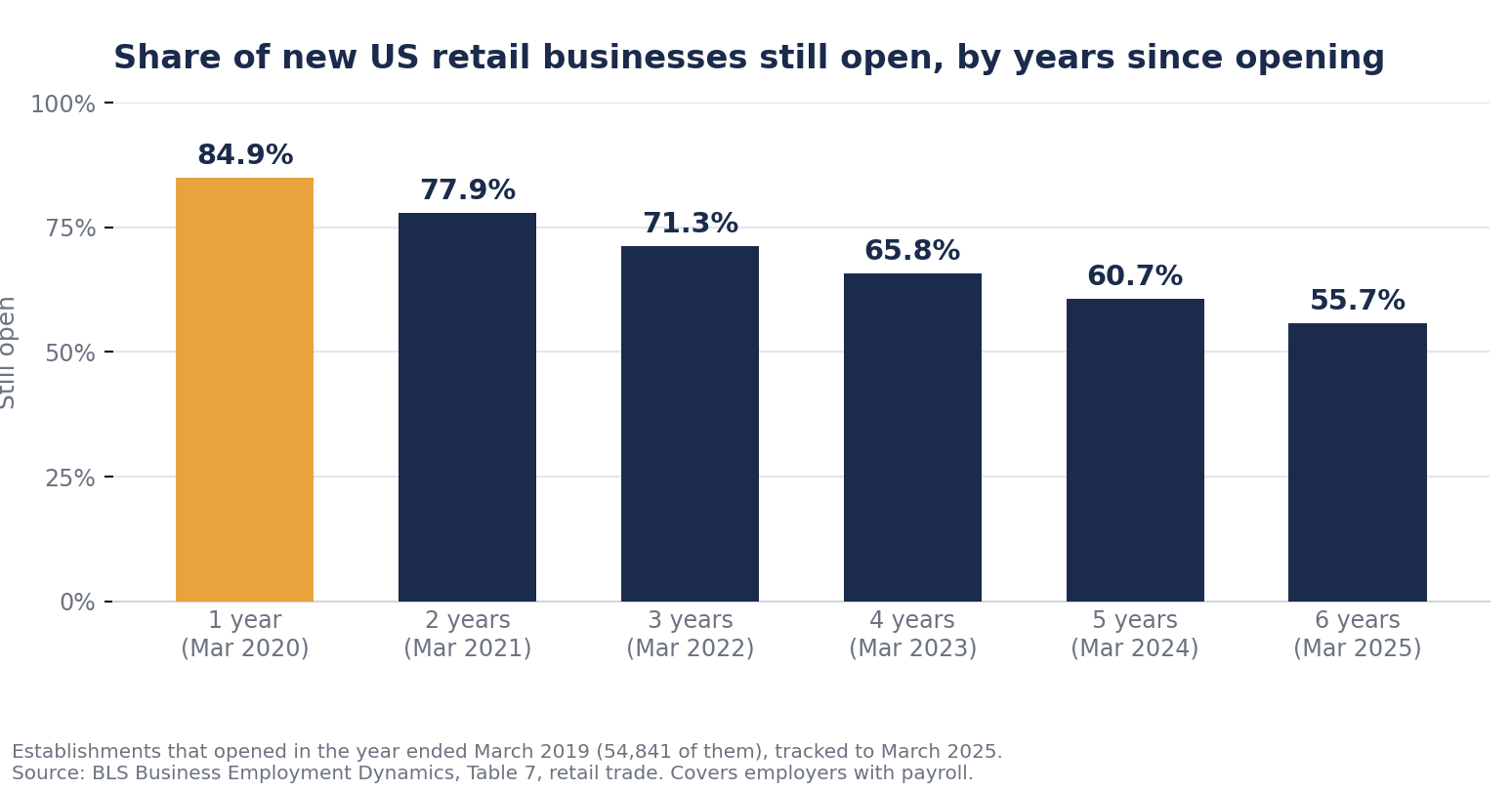
The odds are slower and kinder than the internet says. Of the retail businesses that opened in the year to March 2019, 84.9% were still trading twelve months later. Six years on, 55.7% were still going. After year one the attrition is steady rather than dramatic, close to 8% of the survivors in each following year. One caveat matters to a solo seller. This series counts employers with payroll. A one person store with no staff never enters it, and nobody publishes the equivalent number for those.
You do not need a technical background. Modern platforms like Shopify and WooCommerce handle hosting, security, and payment processing for you. What you need is a willingness to learn basic marketing. You also need patience with tight margins in year one, and enough capital to survive the learning curve.
Nobody publishes a reliable earnings figure for online store owners. Here is why. In 2022 the federal industry codes stopped listing online shopping on its own, so a seller is now counted under whatever they sell. What does get counted is receipts. The 2,081,566 US retail businesses with no staff took in $64,084 each on average in 2023, per the Census Bureau Nonemployer Statistics series. That is money in the door, before you pay for product, shipping and ads. It is not pay. Any site quoting you an average e-commerce salary is guessing.
E-commerce is not a weekend side project that prints money. It demands daily attention to inventory, customer service, ad optimization, and supplier relationships. Truly hands-off is not on offer here.
The people who succeed treat their store like a real business from day one. They track every dollar. They test product ideas before buying inventory, and build an email list alongside their paid ads.
Top Challenges When Starting an E-Commerce Business
1
Average cost-per-click on Google Ads ranges from $1 to $10 or more depending on niche. You need to track ROAS religiously and aim for at least a 2.8 to 1 return to stay profitable.
2
Tying up $5,000 to $20,000 in inventory before demand is proven creates serious cash flow risk. Start with small test batches and use pre-orders to validate before committing to large purchase orders.
3
UPS and FedEx implemented 5.9% base rate hikes in 2026, and consumers expect free or low-cost two-day shipping. You need to bake shipping costs into your product pricing or risk margin erosion.
4
Apparel return rates hit 30% in some categories. Every return costs $15 to $25 in shipping, restocking, and inspection fees, so a clear return policy and accurate product listings are critical.
5
After the Wayfair ruling, most states require e-commerce sellers to collect sales tax once they hit $100,000 in sales or 200 transactions. Tools like TaxJar or Avalara automate this, but you need to register in each state where you have nexus.
Tools & Equipment for an E-Commerce Business
Your core tech stack determines your monthly overhead. A Shopify Basic plan at $39/month or WooCommerce on managed hosting at $15 to $30/month handles your storefront. Add Klaviyo or Mailchimp ($20 to $200/month) for email marketing and automation.
For shipping, ShipStation ($25/month) or Pirate Ship (free, pay-per-label) gives you discounted USPS and UPS rates. If you self-fulfill, invest in a thermal label printer ($100 to $250) and basic shipping supplies ($50 to $300).
Product photography makes or breaks your conversion rate. A $30 to $80 lightbox kit, a tripod, and your smartphone camera produce clean product shots for launch. Canva Pro ($13/month) handles graphic design for social ads and email banners.
Track your finances with QuickBooks Self-Employed ($15/month) or Wave (free). Connect your bank account and payment processor so every sale and expense is recorded automatically. You need clean books to calculate true profit margins and prepare for tax season.
Analytics tools like Google Analytics 4 (free) and your platform's built-in dashboard give you the data to make smart decisions. Install a heatmap tool like Hotjar (free tier available) to see where visitors drop off on your product pages.
Recommended Software for an E-Commerce Business
How to Find Your First E-Commerce Business Clients
Your first 10 customers will most likely come from your personal network. Send a direct message to friends, family, and colleagues who fit your target demographic. A personal recommendation converts at 10x the rate of a cold ad impression.
For your next 50 customers, run small-budget paid ad tests on Meta or Google Shopping. Spend $10 to $20/day across 3 to 5 different creatives and analyze which product images, headlines, and audiences drive the lowest cost per acquisition. Cut losers fast and double down on winners.
Marketplace listings on Amazon or Etsy give you access to built-in buyer traffic. Referral fees range from 15% to 20% of the sale price, but the exposure can validate demand and fund your direct-to-consumer store. Use marketplace sales as a testing ground, then migrate customers to your own site with package inserts offering a discount on direct orders.
Referral programs incentivize your existing customers to bring in new ones. Offer a $10 credit for every referred friend who makes a purchase. This keeps your acquisition cost fixed and builds word-of-mouth momentum that compounds over time.
Email marketing converts at 3 to 5x the rate of social media for e-commerce. Build your list aggressively with a first-order discount pop-up. A 3-email welcome series, a weekly promotional email, and an abandoned cart recovery flow will generate 20% to 30% of your total revenue once your list reaches 1,000 subscribers.
How to Market Your E-Commerce Business
Paid advertising drives the fastest results for new e-commerce stores. Start with Meta (Facebook and Instagram) ads using a $10 to $20/day budget to test 3 to 5 product creatives. Kill underperforming ads within 7 days and scale winners gradually.
Google Shopping ads put your products directly in search results when buyers are actively looking. Cost-per-click ranges from $1 to $10 depending on your niche. Set up a Google Merchant Center account and connect it to your store feed for automated product listings.
Email marketing is the highest-ROI channel for e-commerce. Build your list from day one using a pop-up offering 10% off the first order. Set up a 3-email welcome sequence, an abandoned cart series, and a post-purchase review request. Klaviyo and Mailchimp both offer free tiers for small lists.
SEO is your long-term traffic engine. Write product descriptions that include the exact phrases your customers search for. Start a blog covering buying guides and comparison posts in your niche. SEO traffic compounds over time and has zero marginal cost per visitor.
Influencer marketing works especially well for visual product categories like fashion, home goods, and beauty. Send free product to 5 to 10 micro-influencers with engaged audiences under 10,000 followers. Their recommendations carry more trust than polished brand content.
Social media organic content supports paid ads and builds brand awareness, but it rarely drives meaningful sales on its own for a new store. Treat it as a brand-building channel, not your primary sales driver.
Copy-and-Use Templates
Real templates to help you land your first clients. Click "Copy" and paste directly into your email or messaging app.
First Supplier Outreach Email
emailSubject: Product Inquiry from [Your Business Name] - Interested in Wholesale/Private Label
Hi [Supplier Name],

I am [Your Name], founder of [Your Business Name], an online retailer based in [City, State]. We are launching a new line of [product category] and are looking for a reliable supplier for [specific product or material].

Could you share your minimum order quantities, unit pricing for orders of [100/500/1000] units, and estimated lead times? I would also like to request a product sample before placing a first order.

Please let me know the best way to proceed. I look forward to hearing from you.

Best,
[Your Name]
[Your Email]
[Your Website URL]
Customer Discovery Call Script
scriptHi [Name], thanks for taking a few minutes to chat. I am building [Your Business Name] and want to make sure we are solving a real problem for people like you. First, can you tell me about the last time you purchased [product category] online? What was the experience like? What frustrated you most about the product or the buying process? If you could change one thing about the [product category] you currently use, what would it be? Would you be interested in seeing our first product when it launches? I will add you to our early access list. Thank you for your time. Your feedback is genuinely shaping what we build.
30-Day E-Commerce Launch Checklist
checklistWeek 1: - Validate product demand using Google Trends, Jungle Scout, or Amazon Best Sellers - Register your LLC and apply for your EIN at IRS.gov - Open a dedicated business bank account - Apply for your sales tax permit in your home state Week 2: - Order product samples from 3 or more suppliers - Set up your Shopify or WooCommerce store with a clean theme - Photograph your products with a lightbox and tripod setup - Write product descriptions focused on customer benefits Week 3: - Install Google Analytics and your email marketing tool (Klaviyo or Mailchimp) - Set up abandoned cart email recovery - Create a launch discount pop-up (10% off first order for email signup) - Connect accounting software (QuickBooks or Wave) to your bank and store Week 4: - Launch 3 to 5 paid ad creatives on Meta or Google Shopping at $10 to $20/day - Share your store with your personal network and ask for honest feedback - Send product to 5 micro-influencers for review - Track your cost per acquisition and ROAS daily for the first 2 weeks
Abandoned Cart Follow-Up Email
emailSubject: You left something behind at [Your Store Name]
Hi [First Name],

You added [Product Name] to your cart but did not finish checking out. It is still waiting for you.

If something went wrong during checkout or you have a question about the product, just reply to this email. I personally read every response.

Complete your order in the next 24 hours and use code SAVE10 for 10% off your purchase.

[Link to Cart]

Thanks,
[Your Name]
[Your Store Name]
Post-Purchase Review Request
messageHi [First Name], It has been [7/14] days since your order from [Your Store Name] arrived. I hope you are enjoying [Product Name]. Would you take 60 seconds to leave a review? Your feedback helps other customers make confident decisions and helps us improve. Here is the direct link: [Review Link] As a thank you, here is a code for 15% off your next order: THANKYOU15 Appreciate your support, [Your Name]
Scaling Your E-Commerce Business
These milestones are our own read of where sellers hit a wall. No agency publishes a benchmark for this. Treat them as a sequence, not as targets.
Around $5,000 a month you have a product that works and one channel that repeats. Raise order value first. Bundles, upsells and cross-sells all do it. A second product doubles your photos, stock and support work while the first one is still cheap to improve.
Between $15,000 and $20,000 a month, packing boxes costs more of your time than a fulfillment partner charges for it. Be careful with the per-order rates quoted for third-party logistics. We opened the pricing pages of two of the largest US 3PLs on 28 August 2026. Neither publishes a rate. Both quote per account, and storage is billed by the cubic foot or by the pallet, so a flat monthly storage figure tells you nothing about your bill. Ask for four numbers in writing before you ship them a pallet, the receiving fee, the pick fee, the per-order fee and the storage rate.
Marketplace fees are different. You can price those up front, because Amazon publishes its own. These are the US rates on Amazon's seller pricing page, read on 28 August 2026.
| Amazon seller cost | Published US rate |
|---|---|
| Individual selling plan | $0.99 per item sold |
| Professional selling plan | $39.99 per month |
| Referral fee, Home and Kitchen | 15% of total price |
| Referral fee, Computers and Consumer Electronics | 8% of total price |
| Referral fee, Clothing and Accessories | 5% up to $15, 10% to $20, 17% above $20 |
| Referral fee minimum, most categories | $0.30 per item |
| Closing fee, books, DVD, music, software, video | $1.80 per item |
Fulfillment by Amazon costs extra. Those fees are not on that page at all. Amazon quotes them per product through its Revenue Calculator, which prices your item by size and weight, so run your exact product before you plan a margin around it.
Your first hire tends to arrive between $20,000 and $30,000 a month. It is usually support or ads. Write the process down before you hire, because you are buying back hours and not judgement.
Past $50,000 a month, look at a second channel. Amazon, Walmart Marketplace and wholesale are the usual three. Each one adds work. What it buys is protection from one platform changing its rules on you.
Helpful Resources
Government & Licensing
SBA Licenses and Permits Guide
governmentOfficial guide to finding federal, state, and local licenses and permits required for your business.
IRS EIN Online Application
governmentApply for a free Employer Identification Number in under 10 minutes directly from the IRS.
U.S. Census Bureau E-Commerce Data
governmentOfficial quarterly e-commerce sales reports from the Census Bureau, useful for tracking market trends and total market size.
CBP Notice on Importer of Record Accuracy
governmentThe notice of 19 August 2026 setting out what CBP will void an importer of record number for from 18 September 2026.
CBP IEEPA Duty Refunds
governmentHow refunds of IEEPA duties are filed in ACE, who is allowed to file, and the CBP warning about refund scams.
Business Tools & Software
Shopify
toolThe most popular hosted e-commerce platform for small to mid-size stores, starting at $39/month.
Klaviyo
toolEmail and SMS marketing platform built specifically for e-commerce, with deep Shopify integration and a free tier for up to 250 contacts.
ShipStation
toolShipping and order management software that connects to 100+ carriers and marketplaces, starting at $25/month.
Industry Associations
Training & Certifications
Taxes & Business Structure for an E-Commerce Business
As a self-employed e-commerce owner, you owe 15.3% self-employment tax (Social Security and Medicare) on net profit, plus your regular federal and state income tax. Set aside 25% to 30% of profit for taxes from the start to avoid a painful surprise in April.
Quarterly estimated tax payments are due on January 15, April 15, June 15, and September 15. Missing a payment triggers an underpayment penalty. Use IRS Form 1040-ES to calculate your quarterly amount, or let your accounting software estimate it for you.
Key deductions for e-commerce businesses include cost of goods sold, shipping and fulfillment expenses, platform and software subscriptions, advertising spend, home office deduction (if applicable), and business travel to trade shows or supplier visits. Track every expense with receipts from day one.
Multi-state sales tax is the most complex tax obligation for e-commerce sellers. After the 2018 Wayfair Supreme Court decision, most states require you to collect and remit sales tax once you cross their economic nexus threshold (typically $100,000 in sales or 200 transactions). Automation tools like TaxJar or Avalara handle the calculations and filings for $19 to $99/month.
If your LLC elects S-Corp tax treatment (generally worthwhile above $50,000 in annual profit), you must pay yourself a "reasonable salary" and can take remaining profit as distributions, which are exempt from self-employment tax. Consult a CPA before making this election.
Insurance for an E-Commerce Business
General liability insurance costs an average of $500/year for e-commerce businesses and covers third-party injury claims, property damage, and advertising injury (like copyright infringement). Product liability is often bundled into your general liability policy and covers claims from defective products you sell.
Cyber liability insurance protects against data breaches and cyberattacks. If your store handles any customer payment or personal data, this coverage is essential. Policies start at roughly $500 to $1,000/year for small online retailers. Compare providers in our best business insurance guide.
A business owner's policy (BOP) bundles general liability with commercial property insurance for roughly $1,140/year and is the most common recommendation for e-commerce stores with physical inventory or a home office setup. If you hire employees, workers' compensation insurance is legally required in most states and costs around $86/month for a small team.
Amazon requires sellers exceeding $10,000/month in sales to carry at least $1 million in commercial liability coverage. Even if you only sell on your own site, carrying insurance signals professionalism and protects you from a single lawsuit wiping out your business.
State-by-State Considerations
LLC filing fees range from $35 (Montana) to $500 (Massachusetts). Annual report fees add $0 to $300 depending on your state. Delaware, Wyoming, and Nevada are popular formation states for e-commerce sellers due to favorable tax and privacy laws, but you will still need to register as a foreign LLC in any state where you have physical operations.
Sales tax requirements vary significantly. Five states (Delaware, Montana, New Hampshire, Oregon, and most of Alaska) have no state sales tax. Most other states impose economic nexus thresholds of $100,000 in sales or 200 transactions. California, New York, and Texas have the most complex sales tax structures due to local jurisdiction add-ons.
If you operate from a high-cost-of-living state like California or New York, your overhead for storage, insurance, and local permits will run higher. Many e-commerce operators relocate to states like Texas, Florida, or Tennessee for lower costs and no state income tax, which directly improves net margins.
Frequently Asked Questions
What to Do Next
Ready to launch your e-commerce business? Take these next steps to go from plan to open.
Form Your LLC
Protect your personal assets and establish your e-commerce business as a legal entity. Most states process filings in 1 to 3 weeks.
Get Business Insurance
Compare general liability, product liability, and cyber liability policies for online retailers starting at $42/month.
Open a Business Bank Account
Separate personal and business finances from day one. Many online banks offer free business checking with no minimums.
Build Your Online Store
Compare Shopify, WooCommerce, BigCommerce, and other platforms to find the best fit for your product type and budget.
Explore Small Business Grants
Find grants specifically available for e-commerce startups and product-based businesses that do not require repayment.
Was this article helpful?
Ready to Launch?
Form your e-commerce business LLC today with Northwest. $39 + state fee includes registered agent, business address, domain, and more.
Questions about starting an e-commerce business
No comments yet. Ask the first question and a member of our team will answer.
Leave a comment