How to Start a Cleaning Business
Commercial buildings, not houses, take about 89% of what the US spends on janitorial services. Most founders picture home cleaning, so this guide covers both routes and what each one costs to start.
In This Article
- Overview
- Business Snapshot
- Introduction
- Sub-Niches
- Research Your Local Market and Validate Demand
- Write a One-Page Business Plan
- Cost Breakdown
- Choose Your Business Structure
- Register Your Business and Get Your EIN
- Get Licensed and Bonded
- Licenses & Permits
- Buy Your Equipment and Supplies
- Day-1 Equipment
- Set Your Pricing and Service Packages
- Get Business Insurance Before Your First Job
- Mistakes to Avoid
- Land Your First Five Clients
- Set Up Accounting and Understand Your Taxes
- Marketing Channels
- Build Your Online Presence and Stay Compliant
- Is This Right for You?
- Top Challenges
- Tools & Equipment
- How to Find Clients
- Marketing
- Scaling Your Business
- Taxes & Structure
- Insurance
- State Variations
- FAQ
- Next Steps
What This Guide Covers
This guide walks you through every step to start a cleaning business, from validating your idea to choosing the right legal structure, getting licensed, and reaching your first customers. Updated for 2026.
Business Snapshot
- Startup Cost Range
- $600–$6,000
- Avg. Annual Revenue
- $50,000 - $150,000 (full-time)
- Time to Launch
- 1-3 weeks
- Break-Even Timeline
- 3-6 months
- Avg. Owner Salary
- $43,700 - $52,600/year (solo)
- Avg. Insurance Cost
- $525/year (liability, median)
- Monthly Operating Cost
- $240 - $1,200/month
- Pricing Model
- Per job or hourly
- Avg. Hourly Rate
- $25 - $55/hour
- Avg. Per-Job Rate
- $100 - $300 per job
- Market Growth Rate
- 2.7% a year, 2021 to 2026
- Year-1 Failure Rate
- 24.3% close in year one (BLS, administrative and waste services)
- Marketing Budget
- $100 - $500/month first year
- Recommended Entity
- LLC
- Market Size
- $112.4 billion US janitorial services (2026)
- Last Updated
- August 29, 2026
Industry Trend
Janitorial services in the US is a $112.4 billion industry. It is not booming. It grew 1.7% in 2026, and 2.7% a year across the five years to 2026. The business count grew 4.3% a year over that same stretch, so the field is filling faster than the work is. Commercial work takes about 89% of the revenue, and healthcare and office accounts carry the steadiest demand. The fastest growing slice is exterior window cleaning, forecast at 5.6% a year to 2033, with residential cleaning next at 4.0% against 3.3% for the sector as a whole.
Cost depends on whether you start residential (lower equipment needs) or commercial (floor scrubbers and industrial vacuums add thousands).
What You Need to Know Before Starting a Cleaning Business
Commercial buildings, not houses, take about 89% of what the US spends on janitorial services. Most founders picture home cleaning, so this guide covers both routes and what each one costs to start. The industry is worth $112.4 billion a year and it grew 1.7% in 2026, while the number of cleaning businesses grew 2.4%. The field fills faster than the work. New work comes from winning an account off somebody else, so pricing and follow up matter more than the gear you buy.
A cleaning business is one of the lowest-cost trades you can start, but low cost does not mean easy money. You will be doing physically demanding work, managing unpredictable schedules, and competing with hundreds of other cleaners in your area.
The cleaners who succeed treat this like a real business from day one. That means separate bank accounts, proper insurance, and a pricing structure that actually covers your time and expenses.
This guide walks you through every step from market research to your first client, with real numbers for costs, rates, and timelines.
Cleaning Business Sub-Niches to Explore
Research Your Local Market and Validate Demand
Search "house cleaning" and "office cleaning" in your city on Google. Count the competitors on page one. Read their reviews to find gaps in service quality, pricing, or reliability.
The US janitorial services industry is worth $112.4 billion and it grew 1.7% in 2026, and 1.26 million cleaning businesses already operate nationwide. That count is climbing faster than the money, 4.3% a year against 2.7% over five years. So your first customers are usually somebody else's current customers. Ask what those cleaners are getting wrong. Use our startup cost calculator to model your first 90 days of expenses before spending a dollar.
Pro Tip
Check Thumbtack and Yelp for your zip code. If the top-rated cleaners have fewer than 20 reviews, there is room for a new competitor.
Write a One-Page Business Plan
Your plan needs five things: services offered, target market (residential or commercial), startup budget, monthly expense forecast, and client acquisition strategy. If the numbers do not work on paper, they will not work in real life.
A cleaning business plan does not need to be 30 pages. One honest page beats a polished fiction. Follow our business plan guide for a lean template that takes under an hour to complete.
Pro Tip
Calculate your break-even point before you quit your day job. Divide total monthly costs by your average job price to find how many jobs per week you need.
Startup Cost Breakdown
Itemized estimate for launching a Cleaning Business. Costs vary by location and whether you hire staff.
| Item | Low Est. | High Est. |
|---|---|---|
| Equipment and Supplies (Residential)Includes vacuum, mop and bucket, microfiber cloths, cleaning solutions, spray bottles, gloves, and a caddy. | $300 | $600 |
| Business Registration and LLC FilingLLC filing fees range from $35 to $500 depending on your state. | $35 | $500 |
| Business License and PermitsMost cities require a general business license before you start operating. | $100 | $200 |
| General Liability Insurance (First Year)A median house cleaning policy is $525 a year on Insureon's book. Employees, commercial work or pressure washing push it higher. | $500 | $900 |
| Janitorial BondA median janitorial bond runs about $120 a year. Commercial contracts often require one. | $100 | $200 |
| Marketing (First 3 Months)Google Business Profile is free; budget extra for business cards, flyers, or Google Local Service Ads. | $0 | $500 |
| WebsiteA one-page site with services, pricing, and a booking form is enough to start. | $0 | $500 |
| Working Capital ReserveCovers gas, supply restocking, and slow payment weeks during your first two months. | $500 | $2,000 |
| Total Estimate | $1,535 | $5,400 |
Residential jobs typically run $100 to $300 per visit depending on home size and cleaning depth. Commercial contracts price at $0.07 to $0.25 per square foot or $25 to $90 per hour based on facility type and frequency.
Choose Your Business Structure
Register as an LLC. It separates your personal assets from business liability, which matters when you are inside someone's home every day. Filing costs $35 to $500 depending on your state.
A sole proprietorship is cheaper but offers zero liability protection. One broken vase or slip-and-fall claim could wipe out your personal savings. Follow our LLC formation guide for a state-by-state walkthrough.
Pro Tip
Choose an LLC from day one. You can elect S-Corp tax treatment later once annual profit clears $50,000 and the savings outweigh the payroll admin cost.

Form Your Cleaning Business LLC with Northwest
An LLC separates your personal assets from business liability, which matters when you are working inside other people's homes and offices every day.
Register Your Business and Get Your EIN
File your LLC with your state's Secretary of State office. Then grab your free EIN from the IRS online portal. The EIN takes 10 minutes and costs nothing.
Every state requires a registered agent for your LLC. You can serve as your own or hire a service for $50 to $150 per year. See our registered agent guide for options.
Pro Tip
Use our business name generator to brainstorm names, then verify availability with your Secretary of State and on social media.
Get Licensed and Bonded
Licensing requirements vary by city and state. Here is what most cleaning businesses need:
- General business license from your city or county ($100 to $200 per year)
- State LLC registration (already completed in Step 4)
- Janitorial bond (median $120 per year) for commercial clients
- Workers compensation insurance once you hire employees (required in most states)
Check your specific requirements at the SBA license and permit tool. Use our compliance calendar to track renewal dates.
Pro Tip
Some cities require a separate home occupation permit if you run the business from your residence. Call your city clerk's office before you start.
Important
Operating without a business license can result in fines of $500 or more in many municipalities. Get licensed before your first job.
Licenses & Permits for a Cleaning Business
Requirements vary by state and city — confirm with your local government before opening.
General Business License
RequiredRequired in most municipalities; costs $100 to $200 annually.
Apply / Learn MoreLLC or Business Registration
RequiredFile with your state's Secretary of State office. Fees run from $35 in Montana to $500 in Massachusetts. Filing online in Massachusetts costs $520.
Apply / Learn MoreEIN (Employer Identification Number)
RequiredFree from the IRS and takes about 10 minutes to complete online.
Apply / Learn MoreJanitorial Bond
Not legally required in most states but expected by commercial clients. A median bond runs about $120 a year.
Apply / Learn MoreWorkers Compensation Insurance
Required once you hire employees; mandated in nearly all states.
Apply / Learn MoreNote
ISSA offers the Cleaning Management Institute (CMI) Custodial Technician Certification for cleaners who want to stand out. Green cleaning certifications from Green Seal also help you command premium pricing for eco-friendly services.
Buy Your Equipment and Supplies
Your basic residential kit costs $300 to $600. That covers a HEPA vacuum ($100 to $400), mop and bucket ($30 to $80), cleaning solutions ($50 to $150), spray bottles, gloves, and a caddy.
Skip commercial-grade equipment until you land commercial contracts. A floor scrubber alone runs $500 to $2,000. Start with what fits the jobs you have, not the jobs you hope to get.
Pro Tip
Buy multi-purpose concentrate cleaners and dilute on-site. This cuts your supply costs by up to 40% compared to buying individual bottles.
Day-1 Equipment for a Cleaning Business
These are the essentials you need before taking your first job. Prices are estimates — shop used gear to cut startup costs.
HEPA Filter Vacuum Cleaner
$100 - $400Skip the cheapest models; mid-range vacuums last longer and clean better on both carpet and hard floors.
Microfiber Mop and Bucket Set
$30 - $80Microfiber mops outperform cotton on every surface and dry faster between jobs.
Cleaning Solution Kit (Multi-Purpose Concentrates)
$50 - $150Buy concentrates in bulk and dilute on-site to cut supply costs by 40% or more.
Spray Bottles and Caddy System
$20 - $35A portable caddy keeps supplies organized and saves time at each job site.
Rubber Gloves (Bulk)
$10 - $20Replace monthly for hygiene; buy in bulk packs of 50 or more.
PPE (Masks and Safety Goggles)
$15 - $30Non-negotiable for safety when working with chemical cleaners.
Dusting Tools and Telescoping Extension Pole
$20 - $40Extension poles save your back and reach ceiling fans and high shelves without a ladder.
Commercial Floor Scrubber (Commercial Only)
$500 - $2,000Consider leasing before buying if you are testing commercial accounts.
Set Your Pricing and Service Packages
Residential house cleaning rates range from $25 to $55 per hour or $100 to $300 per job depending on home size and cleaning depth. Deep cleans and move-out jobs command $200 to $550 per visit.
Commercial cleaning typically prices at $0.07 to $0.25 per square foot or $25 to $90 per hour. Your pricing must cover labor, supplies, travel time, insurance, and a margin on top. Add at least twenty percent. That is our rule of thumb, not an industry figure.
Pro Tip
Start with hourly pricing for your first 10 clients to learn how long jobs really take. Switch to flat-rate pricing once you can accurately estimate job duration.
Get Business Insurance Before Your First Job
General liability insurance is cheaper than most guides claim. A house cleaning business pays a median of $44 a month, about $525 a year. That is Insureon's own book of cleaning policies. Across the cleaning trades, 86% pay under $100 a month. It covers damage and injury claims. Add a janitorial bond, a median $10 a month, if you clean commercial spaces.
Workers compensation is required once you hire. It runs a median $116 a month for house cleaning, about $1,395 a year. Payroll size moves it. Compare quotes from at least three providers using our business insurance comparison guide.
Pro Tip
Some clients will ask for a Certificate of Insurance before hiring you. Having one ready makes you look established and wins contracts faster.
Important
Do not take your first client or job without insurance in place. One incident without coverage can end the business before it starts.
Mistakes to Avoid
Pricing too low to cover supplies, travel time, and insurance costs, then burning out within months.
Skipping general liability insurance and risking a single property damage claim that ends the business.
Using your personal bank account for business income, which creates a tax nightmare at year-end.
Buying expensive commercial equipment before landing a single commercial contract.
Failing to get a written service agreement signed before each recurring client engagement.
Ignoring quarterly estimated tax payments and getting hit with IRS penalties in April.
Trying to serve both residential and commercial clients at launch instead of picking one and doing it well.
Not tracking mileage, which is one of the largest deductions you can take as a cleaning business owner.
Land Your First Five Clients
Your first clients come from people who already know you. Text 50 friends, family members, and former coworkers with a simple offer: first cleaning at a discounted rate in exchange for an honest Google review.
Post in neighborhood Facebook groups and Nextdoor with a photo of your supplies and your rate. Over 80% of people hire a cleaner after an online search, so a completed Google Business Profile with five reviews puts you ahead of most new competitors.
Pro Tip
Offer a $25 referral credit for every new recurring client someone sends your way. Referral clients close faster and cancel less often.
Set Up Accounting and Understand Your Taxes
Open a dedicated business bank account on day one. Never mix personal and business funds. Track every expense, receipt, and mile driven from your first job.
You owe 15.3% self-employment tax on net earnings, plus federal and state income tax. Quarterly estimated tax payments are due in January, April, June, and September. Missing a payment triggers IRS penalties.
Key deductions for cleaning businesses include mileage, supplies, insurance premiums, and equipment. Mileage is the big one. The IRS business rate is 72.5 cents per mile for the first half of 2026, and 76 cents from July 1. Use accounting software to automate tracking and save hours every month.
Pro Tip
Set aside 25% to 30% of every payment in a separate savings account for taxes. Do not touch it until quarterly payments are due.
Top Marketing Channels for a Cleaning Business
Primary
Secondary
Build Your Online Presence and Stay Compliant
Your online presence and annual compliance keep the business running. Stay on top of these items:
- Set up a Google Business Profile (free, and the most important marketing tool you have)
- Build a simple website with services, pricing, and a booking form using a website builder
- Renew your business license annually (check your city's deadline)
- File your LLC annual report (required in most states, fees range from $0 to $500)
- Review and renew insurance policies before they lapse
- Track all deadlines with our compliance calendar
Pro Tip
Ask every satisfied client for a Google review within 24 hours of the job. Ten solid reviews in your first month puts you on the local map.
Is Starting a Cleaning Business Right for You?
Cleaning is physical work. You will spend 6 to 8 hours per day on your feet, bending, scrubbing, and hauling supplies. If you cannot handle that five days a week, this is not your business.
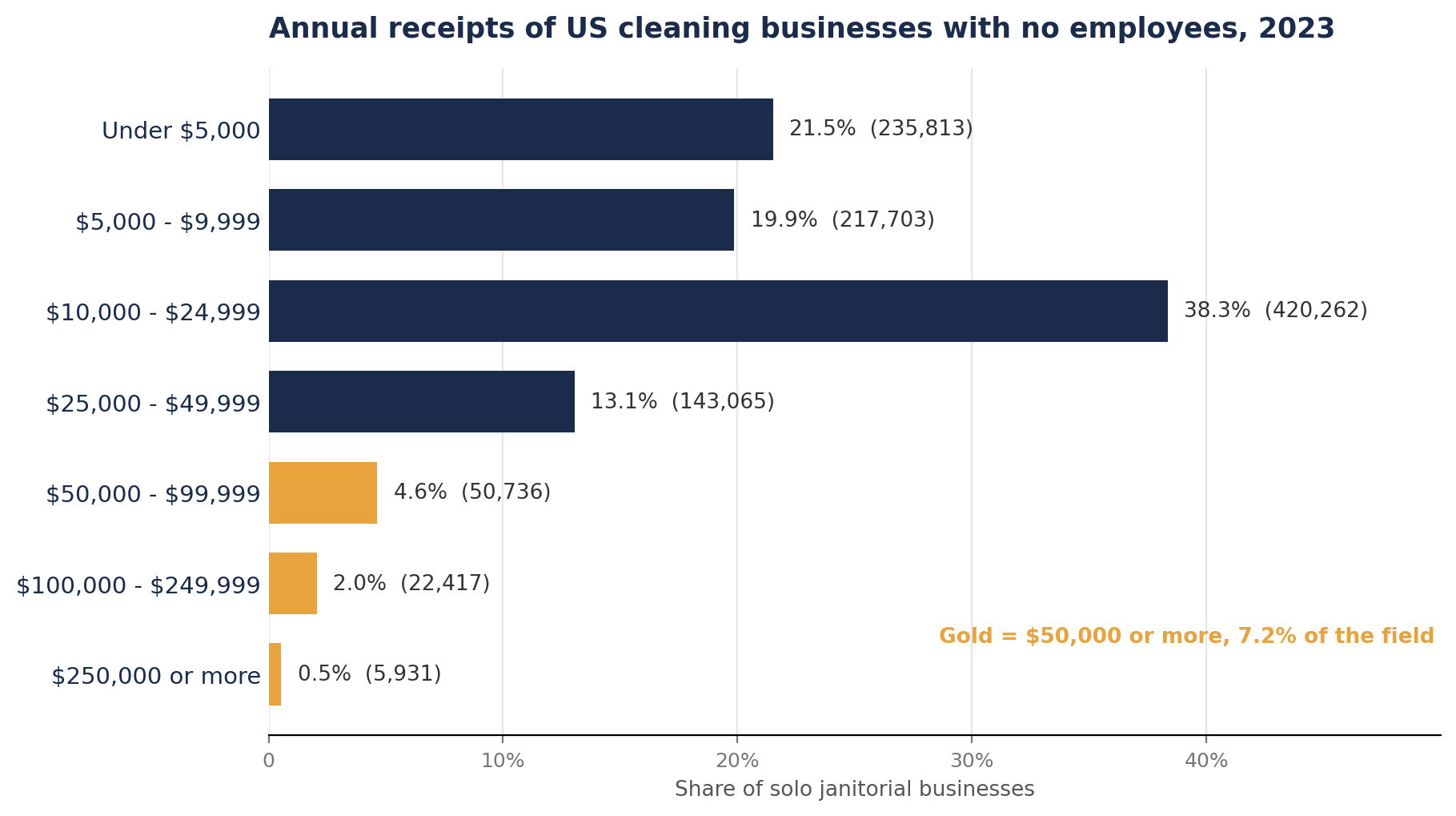
Be suspicious of income figures here, ours included. The Census Bureau counted 1,095,927 US janitorial businesses with no employees in 2023. Of those, 93% booked under $50,000 for the year, and the middle of the field sat between $10,000 and $25,000. That count takes in everyone with receipts of $1,000 or more, so occasional work sits in it beside the full books. A solo cleaner working full time with a full calendar grosses about $50,000 to $56,000. That is the top 7%. Operating costs of $240 to $480 a month and about $525 of insurance come out before you pay yourself. Insurance is the smaller line. A realistic take-home is closer to $43,700 to $52,600 before self-employment tax. A team of 2 to 5 cleaners can reach $100,000 to $150,000 in revenue. Wages come out of that too.
You thrive in this business if you are detail-oriented, reliable, and comfortable working alone in other people's spaces. Clients notice missed spots, dusty baseboards, and streaky mirrors. Perfectionists do well here.
You struggle if you dislike repetitive tasks or expect high income without building systems. The first three months are the grind: low client count, inconsistent income, and a lot of driving between jobs.
Realistic timeline to a livable income: 3 to 6 months for a solo residential cleaner with steady marketing. Commercial contracts can take longer to land but pay more once they are in place.
Plan to use a break-even calculator before you commit. If you need $4,000 per month to cover personal expenses, you need roughly 20 to 30 residential jobs per month at $150 average.
Top Challenges When Starting a Cleaning Business
1
Families move, budgets tighten, and recurring clients cancel without warning. Build a steady pipeline of new leads so one cancellation does not wreck your monthly income.
2
Cleaning 4 to 6 homes per day is physically exhausting. Plan your hiring timeline before your body forces you to.
3
You are working inside other people's homes with their valuables. General liability insurance at a median $525 a year is the cost of staying in business.
4
The national median for a maid or housekeeping cleaner was $17.07 an hour in May 2025. Offer $15 and you are under it. Reliable cleaners have options, and the bottom of the market rehires every few months.
5
Monthly operating costs jump from $240 to $480 solo to $600 to $1,200 with a small team. Plan the cash flow gap before hiring.
Tools & Equipment for a Cleaning Business
Your day-one kit is small. A HEPA-filter vacuum ($100 to $400), microfiber mop and bucket ($30 to $80), multi-purpose cleaning concentrate ($50 to $150), spray bottles, gloves, and a caddy get you through any residential job.
Skip the commercial equipment until you win a commercial contract. Floor scrubbers ($500 to $2,000), commercial vacuums ($400 to $800), and carpet extractors ($1,500 to $5,000) eat cash fast. Rent or lease before you buy.
For software, Jobber and ZenMaid handle scheduling, invoicing, and client management for $30 to $70 per month. QuickBooks or Wave (free) handles bookkeeping. Square processes on-site payments at 2.6% plus 15 cents per transaction.
Google Business Profile is free and non-negotiable. Over 80% of cleaning clients start their search on Google. Pair it with a simple booking website built on a website builder for under $20 per month.
Track client relationships and follow-ups with a CRM tool. Even a free option like HubSpot CRM prevents leads from slipping through the cracks during your busiest weeks.
Recommended Software for a Cleaning Business
How to Find Your First Cleaning Business Clients
Your first 5 clients come from people who already trust you. Send a personal text or email to 50 contacts: friends, neighbors, former coworkers, and family. Offer a first-clean discount in exchange for an honest Google review.
Build a Google Business Profile immediately. Over 80% of people looking for a cleaner start with a Google search. A complete profile with photos, accurate service areas, and 5 or more reviews gets you into the local map pack results.
Google Local Service Ads put you at the very top of search results. You pay per lead (typically $15 to $40 per lead), not per click. For a new cleaning business, LSAs deliver the fastest return on ad spend.
Join 3 to 5 local Facebook groups and your neighborhood Nextdoor community. Post a helpful cleaning tip once a week, not a sales pitch. When someone asks for a cleaner recommendation, your name is already familiar.
Partner with realtors, Airbnb hosts, and property managers for recurring referrals. A single property manager with 20 units can fill your schedule faster than any ad campaign. Deliver consistent quality and they will keep sending work.
How to Market Your Cleaning Business
Your first marketing channel is free: Google Business Profile. Claim it, add photos of your equipment and completed jobs, and ask every early client for a review. Ten reviews in your first month puts you above most local competitors in search results.
Google Local Service Ads (LSAs) appear above regular search results and charge per lead, not per click. They are the fastest paid channel for cleaning businesses because the searcher is already looking to hire right now.
Neighborhood Facebook groups and Nextdoor are high-conversion, zero-cost channels for residential cleaning. Post once per week with a helpful tip or a before-and-after photo. Do not spam; add value first.
Referral programs are your highest-ROI channel long-term. Offer existing clients $25 off their next cleaning for every new recurring client they refer. Referral clients convert faster and cancel less often.
Partner with realtors, property managers, and Airbnb hosts. They need reliable cleaners for move-outs and turnovers and will send you steady work if you deliver consistent results. A single property management relationship can replace 10 one-off marketing efforts.
Budget $100 to $500 per month for marketing in your first year. Allocate most of that to LSAs and save the rest for business cards and door hangers in your target neighborhoods.
Scaling Your Cleaning Business
Most solo cleaners hit a ceiling at 4 to 6 jobs per day. Beyond that, your body breaks down and quality drops. That is the signal to hire your first cleaner.
A first hire costs $15 to $22 per hour depending on your market. The federal Occupational Employment and Wage Statistics survey put the national median for maids and housekeeping cleaners at $17.07 an hour in May 2025, so $15 is a below-median offer in most places. Expect monthly operating costs to jump from $240 to $480 (solo) to $600 to $1,200 with a small team. Workers comp starts with your first employee.
Your first hire should clean alongside you for 2 to 4 weeks before working independently. Use checklists for every job type so quality stays consistent even when you are not on-site.
Once you have two cleaning teams running, your role shifts from cleaner to manager. Focus on sales, scheduling, and quality control. Invest in cleaning business software like Jobber or Housecall Pro to manage multiple crews without drowning in admin work.
The jump from $50,000 solo to $150,000 with a team of two to five is possible within 18 to 24 months. That ceiling is revenue, not pay. Wages, payroll tax, supplies and insurance all come out of it before you take anything, and systems for hiring, training, pricing and client retention have to be in place before you scale.
Taxes & Business Structure for a Cleaning Business
You owe 15.3% in self-employment tax (Social Security and Medicare) on every dollar of net profit. This is on top of your federal and state income tax. It catches many first-year cleaning business owners off guard.
Quarterly estimated payments are due in January, April, June, and September. Miss a payment and the IRS charges penalties plus interest. Set aside 25% to 30% of every payment you receive into a separate tax savings account.
Your biggest deductions are mileage, cleaning supplies, equipment, insurance premiums, software, and marketing. Log every mile. The IRS business rate ran 72.5 cents per mile through June 30, 2026, and rises to 76 cents for the rest of the year, per the IRS standard mileage rates. Track every deduction from day one using accounting software like QuickBooks or Wave.
If your annual profit clears $50,000, talk to a CPA about electing S-Corp tax treatment for your LLC. This can save thousands in self-employment tax by splitting income between salary and distributions. You have to run real payroll to do it, which costs about $660 a year for a one person payroll on Gusto's published $49 a month plan plus $6 per person. Run your own numbers first.
Insurance for a Cleaning Business
General liability insurance is your baseline. It covers property damage and injury claims. For a solo residential cleaner it runs a median of $44 a month, about $525 a year, for $1 million per occurrence, on Insureon's book of house cleaning policies. Across the cleaning trades, 86% pay under $100 a month. Pressure washing costs more. You cannot responsibly clean someone's home without it.
A janitorial bond costs a median $10 a month, about $120 a year. It covers theft by you or your employees. Many commercial clients require one before signing. It is cheap and it builds trust.
Workers compensation becomes mandatory once you hire your first employee. House cleaning firms pay a median $116 a month, about $1,395 a year. Across the cleaning trades it is $136. Add commercial auto if you drive a work van.
Compare at least three providers before buying. Use our business insurance comparison guide to find carriers that specialize in cleaning businesses and bundle policies for discounts.
State-by-State Considerations
Licensing requirements vary significantly by state and city. Some states (like Georgia) require general liability insurance, workers compensation, and commercial property insurance before you can legally operate. Others have minimal requirements beyond a basic business license.
LLC filing fees run from $35 in Montana to $500 in Massachusetts. Massachusetts is the outlier. It charges $520 to file online rather than by mail. Its annual report then costs $500 again every year. Elsewhere that report runs from nothing to a few hundred dollars. Check your Secretary of State site for the current number.
Cleaning rates also shift by geography. Urban markets like New York and San Francisco support $45 to $65 per hour residential rates, while smaller cities may cap out at $25 to $35 per hour. Research local competitors before setting your prices.
Frequently Asked Questions
What to Do Next
Ready to launch your cleaning business? Take these next steps to go from plan to open.
Form Your LLC
Protect your personal assets by registering your cleaning business as an LLC. Our guide covers every state's fees and filing steps.
Get Business Insurance
Compare general liability and janitorial bond quotes from top carriers. A solo residential cleaner pays a median $525 a year.
Open a Business Bank Account
Separate your personal and business finances from day one. See which accounts offer free transactions and no monthly fees.
Join ISSA (Cleaning Industry Association)
Access training, certifications, and networking with over 11,000 cleaning industry members worldwide.
Was this article helpful?
Ready to Launch?
Form your cleaning business LLC today with Northwest. $39 + state fee includes registered agent, business address, domain, and more.
Questions about starting a cleaning business
No comments yet. Ask the first question and a member of our team will answer.
Leave a comment