
MCA Debt Relief, Every Honest Exit and the Rescue Offers to Avoid
The rescue ads on this search are often a second trap. We map the honest exits instead. Reconciliation, attorneys, SBA refinancing, and a plain answer on why we list no relief partner, none has passed our vetting.

In This Article
- Quick Answer
- Top Pick: Lendio
- Side-by-Side
- Full Reviews
- How to Choose
- What an MCA Loan Default Actually Triggers
- The Lien You Probably Did Not Notice
- What You Guaranteed Personally, and What You Did Not
- Confessions of Judgment and Why Fewer of Them Stick Now
- The Reconciliation Clause Is a Term You Already Signed
- What Your State Forces the Funder to Put in Writing
- The Honest Exits, In Order
- Getting the Lien Released Once You Have Paid
- The Rescue Offers to Avoid
- Why We List No Relief Partner
- FAQ
- Reconciliation is a term you already signed. It adjusts your payment when sales fall short. Check the verb. A clause saying the provider shall reconcile is worth far more than one saying it may.
- A UCC-1 lien survives your final payment. Paying is not enough. You must demand a termination in writing, and section 9-513(c) then gives the funder 20 days to act.
- Most MCA guarantees are performance guarantees. They bite on specific acts, like diverting card sales. Not on the business simply failing.
- Eleven states require written disclosure on sales based financing. Only 2 make the provider state an annualized rate.
- We list no relief partner on purpose. None has passed our vetting. The 2 cheapest exits here earn us nothing.
Trapped in a merchant cash advance? The people advertising rescue are often selling a second trap. MCA debt relief is a real need with a predatory supply. Eleven states now force a funder to put the cost in writing, and only 2 of them make it state a rate you can compare. This page maps every honest exit, what each one costs, and the red flags on the rescue offers themselves. It also lays out what a default actually sets in motion, and what the funder holds over you in the UCC filing and the guarantee you signed.

Lendio
APR from 8%
Get StartedSide-by-Side Comparison
| Feature | ||
|---|---|---|
| Best for | Pricing consolidation offers across the market | SBA refinancing when revenue supports it |
| Pricing | 9.75% to 60% APR by lender | SBA capped rates and fees |
| Speed | 1 business day to offers | Weeks, SBA process |
Full Reviews
Lendio gives you one application to shop 75+ lenders, but your data goes wide and final rates can climb past 50% APR.
Time in business: 6+ months
Min. revenue: $50K/year
Pros
- One 15-minute application reaches 75+ lenders, saving hours of individual applications across different platforms
- Accepts borrowers with credit scores as low as 560, giving subprime borrowers more options than most direct lenders offer
- Wide product range covering term loans, lines of credit, SBA 7(a), MCAs, equipment financing, and invoice factoring through a single portal
- Dedicated funding specialists walk first-time borrowers through product selection at no charge to the borrower
Cons
- Your personal and business data (including SSN and tax returns) is shared with multiple third-party lenders who may retain it permanently and contact you aggressively via phone, email, and text
- APR range stretches to 60%, and you cannot see actual rates until after submitting your full application, making upfront comparison impossible
- Revenue-based financing is repaid as a share of daily revenue rather than at a stated APR, so its true annualized cost is hard to compare against a term loan
- Customer support is limited to weekday business hours (Mon-Fri 7:30am-5pm MT), and multiple BBB and Reddit complaints describe unresponsive service after the initial application
- Once matched with a lender, Lendio is no longer involved in servicing your loan, leaving you without an advocate if problems arise
SmartBiz connects established small businesses with SBA 7(a) loans through a tech-driven portal, but stacked fees and slow funding timelines still frustrate borrowers.
Time in business: 3+ years
Min. revenue: $50K/year
Pros
- SBA 7(a) APRs starting at 9.75% are competitive with the best available rates for small business loans under $350,000
- Trustpilot score of 4.6 from 16,361 reviews, with borrowers consistently praising the dedicated Relationship Managers
- Now a federally chartered bank (SmartBiz Bank, N.A.) under OCC oversight, which adds regulatory accountability that pure marketplace lenders lack
- Document upload portal and single application across multiple SBA lenders saves significant time compared to applying at individual banks
- 60% of loans approved through SmartBiz have gone to women, veteran, and minority business owners
Cons
- Stacked fees on term loans (3% referral + 3% packaging) add up to 6% before interest, far above the 1-3% origination fee charged by direct lenders
- SBA loan funding routinely takes 6 to 12 weeks despite the platform advertising 7 to 30 day timelines
- Borrowers report communication gaps during underwriting, including ignored emails and weeks without status updates
- Lines of credit carry APRs up to 35.31% plus a 6% origination fee, making them expensive compared to credit union alternatives
- Three-year time-in-business requirement, plus a 1.1x debt service coverage minimum, excludes startups and early-stage businesses entirely
How to Choose
Revenue dropped and the daily pulls no longer fit
Invoke your reconciliation clause in writing first, then price consolidation offers, one form reaches 75 plus lenders.
Healthy revenue trapped under expensive stacked advances
An SBA loan can retire MCA balances when revenue supports it, capped fees, real amortization, slower on purpose.

What an MCA Loan Default Actually Triggers
A merchant cash advance is not a loan, at least not on paper. An MCA is sold as a purchase of your future sales. That wording is not marketing. It drives the paperwork, and it is why a default here looks nothing like missing a loan payment. Repayment is an automatic debit. So the first event is rarely a letter. It is a withdrawal that does not clear.
After that, things tend to happen in a set order. Almost none of it involves a judge.
- Fees land twice on one failed debit. Your bank charges an insufficient funds fee. The funder charges its own rejected payment fee. Many agreements let it try the debit again, so one short day can cost you several charges in a week.
- The funder declares a default. Find this clause in your own agreement. The definition is usually much wider than a missed payment. Changing card processors, taking a second advance, moving your deposits, or closing the debited account are each often written in as a default on their own. Every payment can be on time and you are still in default.
- The balance accelerates. The whole remaining payback amount comes due at once. Not the smaller sum you would have paid over the rest of the term. Most advances run 3 to 18 months, so acceleration can pull a year of payments into a single demand. On an advance priced by a factor rate, that figure carries the funder's full margin, because the cost was fixed the day you signed.
- Collection turns to what you pledged. That means the lien filed against the business and the guarantee you signed. Both are covered below. Most people meet them for the first time right here.
Writing the chain out has a point. The early links are paperwork, not court orders. Paperwork can still be argued about. It stops being negotiable roughly in the order above. Our merchant cash advance guide covers factor rates and holdbacks if pricing is what you need.
The Lien You Probably Did Not Notice
When a funder advances money it almost always files a UCC-1. That is a one page public notice. It says somebody claims a security interest in your assets. It is not a judgment and it moves no money. What it does is set who gets paid first if there is ever anything to divide.
Two things about it matter long before any default. The first is scope. Many MCA filings cover all assets, not just the sales being bought. That is a much wider claim than most readers think they agreed to. The second is visibility. The next lender you approach will search the filing office and find it. Founders often learn that an old advance is why a bank said no, months after the balance stopped mattering to them.
Go and read your own filing. Every state runs a free UCC search through its Secretary of State. The record shows the secured party, the filing date and the collateral described. It takes a few minutes. If the collateral line is wider than the deal you agreed to, raise it with an attorney while you still have leverage.
What You Guaranteed Personally, and What You Did Not
An advance is structured as a sale, not a loan. A full personal guarantee would cut against that. If you personally promised to repay whatever happened to the business, the deal starts to look like lending. Then state usury limits come into play. So most agreements use a narrower promise instead. It is often called a performance guarantee or a validity guarantee.
The difference is real. A performance guarantee does not usually make you liable because the business failed and the sales never came. It makes you liable for specific acts. The list is short, and it covers things like misstating your revenue on the application, or routing card sales to another account to keep them away from the debit.
So does an advance follow you home? It depends on which document you signed and what the business did next. No page on the internet can read that for you. It is also the most misrepresented term in this industry, and there is a federal record proving it. The FTC sued RCG Advances, formerly Richmond Capital Group. It alleged the company's websites claimed its advances needed no personal guaranty of collateral from owners, while the contracts required exactly that. The 2022 order banned the company and its owner from the industry for good. It also required more than $2.7 million in refunds.
Confessions of Judgment and Why Fewer of Them Stick Now
A confession of judgment is an affidavit you sign at the start. In it you agree the funder may enter judgment against you without suing you first. You get no chance to argue. For years these were signed in bulk at closing, then filed in New York county courts against merchants who had never set foot in the state. That is how an advance taken in one state froze a bank account in another overnight.
New York changed that. CPLR 3218(b) now allows filing only with the clerk of the county where the defendant said they lived when the affidavit was signed, or where they lived when it was filed. The statute adds that a company resides in any county where it has a place of business. So a New York funder can no longer walk a confession signed by an out of state merchant into a New York courthouse.
That is a limit on where, not a national ban. States differ on whether these hold up. What it means for your agreement is a question for a lawyer in your state. The same FTC order also made the defendants vacate judgments already entered against former customers and release liens on their property. An entered judgment is not always the end of the argument.
The Reconciliation Clause Is a Term You Already Signed
Reconciliation is the one exit written into your own contract. Funders mention it least.
The clause lets you ask for your payment to be adjusted when sales come in below what the fixed debit assumes. It is there for the funder as much as for you. A payment that never moves, whatever the business earns, starts to look like a loan with a fixed schedule. Courts asking whether an advance is really a disguised loan have looked hard at whether reconciliation was available in practice. That is why the clause exists.
Find it before you call anyone. It may be headed reconciliation, adjustment, true up, or retrieval percentage. 2 details decide what it is worth. The first is the verb. A clause saying the provider shall reconcile on request is a different thing from one saying it may reconcile at its discretion. That one word is what a court would look at. The second is the procedure. It usually wants a written request inside a set window, with bank or processing statements attached. Missing the window does not end the argument. It does hand the funder an easy answer.
Invoking reconciliation means asking for the deal you signed to be applied. That is not stopping payment. Nothing here should be read as advice to stop paying. A funder ignoring a mandatory reconciliation duty has a problem. Show that problem to an attorney, not to a settlement firm.
What Your State Forces the Funder to Put in Writing
Eleven states now make a provider of sales based financing hand you a standard written disclosure. Only 2 require an annualized rate. Those are California and New York. That is the number that lets you compare an advance to a loan. The other 9 stop at the finance charge and the total you will repay. That split explains a lot about how this product is sold.
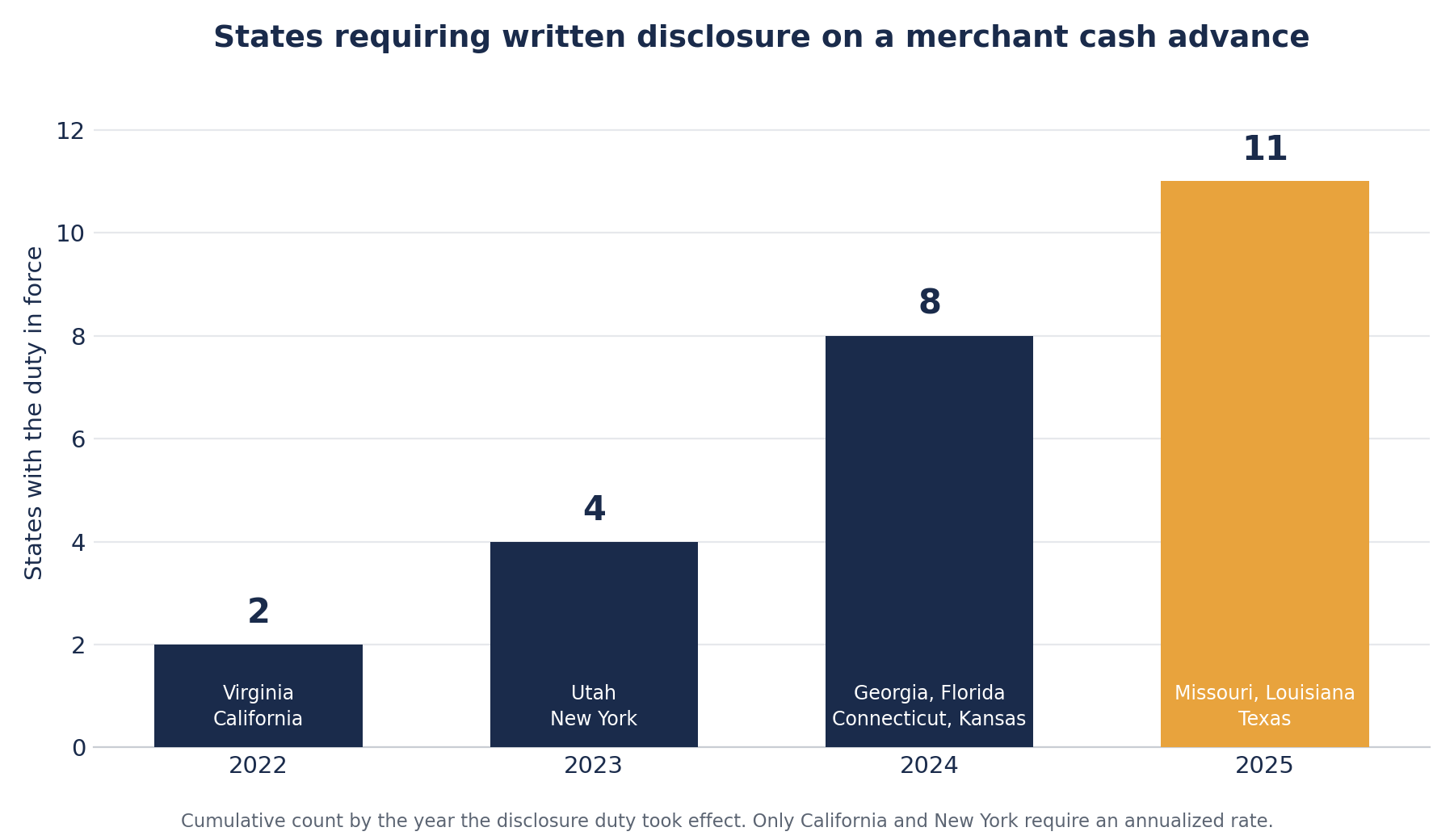
Timing matters as much as content. Five states want the disclosure when the provider makes a specific offer. That is early enough to compare two deals. The other six require it only at or before signing, when the decision is effectively made.
| State | Duty in force | Disclosure due | Annualized rate required |
|---|---|---|---|
| California | December 9, 2022 | At the specific offer | Yes |
| New York | August 1, 2023 | At the specific offer | Yes |
| Virginia | July 1, 2022 | At the specific offer | No |
| Connecticut | July 1, 2024 | At the specific offer | No |
| Texas | September 1, 2025 | At the specific offer | No |
| Utah | January 1, 2023 | Before you sign | No |
| Georgia | January 1, 2024 | Before you sign | No |
| Florida | January 1, 2024 | At or before signing | No |
| Kansas | July 1, 2024 | At or before signing | No |
| Louisiana | August 1, 2025 | At or before signing | No |
| Missouri | 2025, see note | At or before signing | No |
Two notes on that table. Missouri sets its own start date by a condition, six months after the Division of Finance finalizes rules, or February 28, 2025 if it never meant to write any. We could not confirm the Division's position at a primary source, so treat that date as approximate. Connecticut is often described elsewhere as an annualized rate state. It is not. Its prescribed form carries no such field.
California went further in 2026. Financial Code section 22806 bars a provider from using the words interest or rate deceptively. Once a specific offer is on the table, any time it states a charge or a pricing metric, it must state the annualized rate too.
Say you are in one of these 11 states and no disclosure ever reached you. Write that down with the date. Show it to an attorney or your state regulator. It does not void the agreement on its own, and anyone telling you that it does is selling something.
The Honest Exits, In Order
These run cheapest first. Most people qualify for more than one. Taking an early option does not rule out a later one.
- Invoke reconciliation and negotiate. Free, immediate, and it uses a term already in your contract. A funder usually prefers a smaller payment that keeps arriving to a default that pays nothing. Put it in writing. Keep the copy.
- Hire an attorney who works MCA cases. This costs real money by the hour. It also buys real leverage, especially where a reconciliation duty was ignored or a guarantee is being read wider than it was written. It tends to earn its fee once stacked advances reach serious money. A first consultation is cheaper than most people expect.
- Refinance into cheaper debt. A term loan retires the advance and swaps a daily debit for a monthly payment. An SBA 7(a) loan is the cheapest version when revenue supports it. SBA sets no single rate. It caps what a lender may charge. With the prime rate at 6.75% on August 21, 2026, those ceilings run from 13.25% on the smallest loans down to 9.75% above $350,000. Next to a factor rate, that is a different world. SmartBiz packages that route. One Lendio form prices consolidation offers across its lender panel. Both move slower than the advance did. That is the point.
- Restructuring or insolvency counsel. When the arithmetic has no exit, this is a professional conversation and not a failure. Sooner beats later. Several options above vanish once a judgment exists.
Getting the Lien Released Once You Have Paid
Paying the balance does not clear the UCC-1. Someone has to file a UCC-3. That is the form used to terminate a financing statement. The funder has little reason to think about it once your money has landed. This is the most skipped step on this page. It is also the one that quietly costs people their next approval.
Article 9 of the Uniform Commercial Code gives you a lever. For business collateral, section 9-513(c) sets a clock. Within 20 days of getting a written demand from you, the secured party must send or file a termination statement. That holds as long as nothing is still owed and no further advance is committed. Your demand starts the clock, not your final payment. Until you ask, nothing happens.
Article 9 is enacted state by state. Check your state's version and numbering. Then run the free Secretary of State search again a few weeks later. A promised termination is not a filed one.
The Rescue Offers to Avoid
The search that brought you here is one of the most expensive in small business finance. That tells you what the advertisers expect to make. 3 patterns come up again and again.
- Reverse consolidation. New money advanced to service the old advances. The daily debit drops, which feels like relief. The total owed grows. One trap paying another is still two traps.
- Big fees charged before any result. Settlement operators are the loudest advertisers on these keywords, and the FTC has acted in this space, including a 2022 order that banned one funder for good and required more than $2.7 million in refunds. Money up front with success promised later is the shape to distrust. The name on the door does not change it.
- Advice to stop paying with no legal plan. Someone who opens by telling you to halt your debits, with no attorney and no plan for the default that follows, is manufacturing the event that hands the funder acceleration and collection rights. That is not a negotiating position. It is the funder's best day.
One question cuts through most of it. Ask what they will do, which clause of your agreement they will use, and what happens if it fails. Anyone working from your contract can answer. Anyone working from a script will steer back to the fee.
Why We List No Relief Partner
We name tested partners on every other lending page here. There is none on this one. That is deliberate.
No MCA relief or settlement operator has passed our vetting. Most fail on first contact. The 2 refinance routes above are roster members we have tested, and we earn a referral fee if you use them. That is disclosed on every page of this site. The reconciliation, attorney and insolvency routes earn us nothing at all. They are listed first because on this page they are usually the better answer. If a relief operator ever clears our bar, this section will name it.
Frequently Asked Questions
Usually in this order. A debit fails, and both your bank and the funder charge a fee. The funder declares a default, which in most agreements covers far more than a missed payment. Switching card processors or taking a second advance can be enough. The full remaining payback amount then accelerates and comes due at once. Collection turns to the UCC-1 lien on the business and the guarantee you signed. Most of that chain is paperwork, not a court order. That is why acting early matters.
Yes, and there are 4 routes, cheapest first. Invoke your reconciliation clause and negotiate directly. Hire an attorney who works MCA cases for leverage. Refinance into an SBA loan or cheaper term debt when revenue supports it. Take restructuring counsel when the arithmetic has no exit. Taking an early option does not rule out a later one.
A reconciliation clause lets you ask for your payment to be adjusted when sales come in below what the fixed debit assumes. Funders rarely volunteer it. You invoke it in writing, usually inside a set window, with bank or processing statements attached. It is often the fastest relief available. Check 1 word before you call, whether the clause says the provider shall reconcile or may reconcile, because that verb carries the weight.
Almost always. The funder files a UCC-1 financing statement with a state filing office, which is a public notice claiming a security interest in your assets. Many MCA filings are written against all assets rather than only the receivables purchased. It takes no money by itself, but any lender you approach next will find it, and it is a common reason a later loan application is declined.
It depends which document you signed. An advance is structured as a sale, not a loan. So most agreements use a performance or validity guarantee rather than a full personal guarantee. That narrower promise does not usually make you liable because the business failed. It makes you liable for specific acts, such as misstating revenue or routing card sales away from the debited account. Have an attorney read your actual guarantee. A 2022 FTC order banned a funder that advertised no personal guaranty while its contracts required exactly that.
Paying the balance does not clear it. A UCC-3 termination has to be filed, and the funder has little reason to do it unprompted. Under Uniform Commercial Code section 9-513(c), for business collateral the secured party must send or file a termination statement within 20 days of receiving a written demand from you, as long as nothing is still owed. Your demand starts the clock, not your final payment. Article 9 is enacted state by state, so check your version, then re-run the free Secretary of State search to confirm.
Eleven states require a standard written disclosure on sales based financing. Only 2 require an annualized rate. Those are California and New York, and that rate is what lets you compare an advance to a loan. The other 9 stop at the finance charge and the total you will repay. California, New York, Virginia, Connecticut and Texas require it when a specific offer is made. Utah, Georgia, Florida, Kansas, Louisiana and Missouri require it only at or before signing.
Some are, many are not. Reverse consolidations advance new money to service old advances and grow the total owed. The FTC has taken action against operators in this space, including a 2022 order that permanently banned RCG Advances and its owner from the merchant cash advance industry and required more than $2.7 million in refunds. Never pay large fees before a documented result, and treat any advice to stop paying that comes without a legal strategy as the funder's best day rather than yours.
When your revenue supports it, yes. An SBA 7(a) loan can retire an MCA balance and replace a daily debit with a monthly payment. SBA does not set one rate, it caps what a lender may charge, and with the prime rate at 6.75% on August 21, 2026 those ceilings run from 13.25% on the smallest loans down to 9.75% above $350,000. It runs slower than the advance did, which is the point.
Was this article helpful?
This page is for educational and informational purposes only and is not legal or professional financial advice. MCA contracts vary and state law matters, consult a qualified attorney about your specific agreement before acting. Geekdiys earns a referral fee on some providers, which does not affect our guidance.
Sources & References
- FTC, Ban for Richmond Capital and Owner From the Merchant Cash Advance Industry
- FTC, Small Business Financing Staff Perspective
- Uniform Commercial Code section 9-513, Termination Statement
- New York CPLR 3218, Judgment by Confession
- California Financial Code section 22802, Commercial Financing Disclosures
- California Financial Code section 22806, Rate Statements After a Specific Offer
- New York DFS, 23 NYCRR Part 600 Commercial Finance Disclosure
- Virginia Code chapter 22.1, Sales-Based Financing Providers
- Texas Finance Code chapter 398, Commercial Sales-Based Financing
- SBA, 7(a) Loan Program Terms and Conditions
Questions about MCA Debt Relief, Every Honest Exit and the Rescue Offers to Avoid
No comments yet. Ask the first question and a member of our team will answer.
Leave a comment